About Mimus dorsalis (Orbigny & Lafresnaye, 1837)
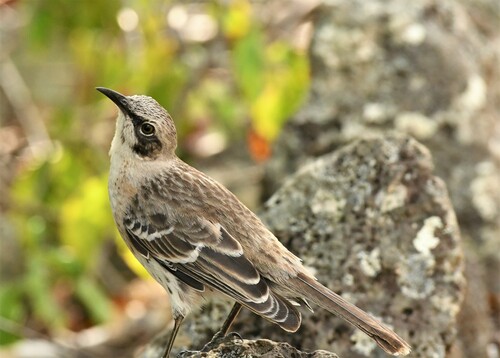
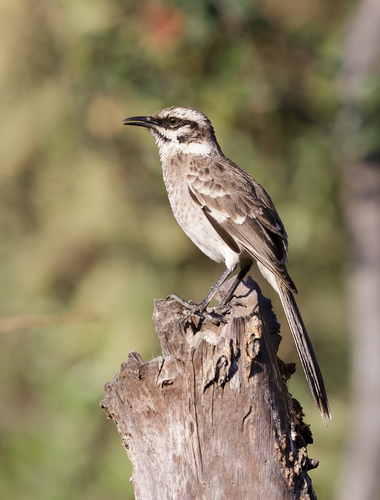
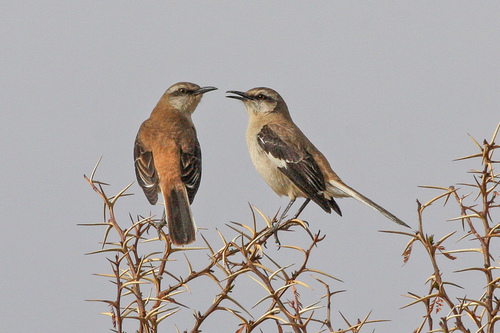
The brown-backed mockingbird (scientific name Mimus dorsalis (Orbigny & Lafresnaye, 1837)) measures 21 to 25.5 cm (8.3 to 10.0 in) in length, and weighs between 52 and 65 g (1.8 and 2.3 oz), with an average weight of 58.7 g (2.07 oz). Adult individuals have a distinct whitish supercilium, a black line running through the eye, and dusky cheeks. Their crown and upperparts are chestnut brown, with the brightest coloration on the rump, and the crown has darker streaks. Most of the tail is blackish, but the outer three to four tail feathers are white. The underside of the bird is whitish, with a buff tinge on the chest, sides, and flanks. Juvenile brown-backed mockingbirds are similar in appearance to adults, but also have dusky spotting on their breast.
Most of the species' range is in western and southern Bolivia, extending south from La Paz Department. It also ranges into northwestern Argentina as far south as Tucumán Province. The brown-backed mockingbird lives in arid landscapes including brush, desert shrubs, and hedgerows, and is often found near human habitation. Most of the population occurs at elevations between 2,300 and 3,500 m (7,500 and 11,500 ft), though individuals can be found as low as 1,700 m (5,600 ft) and as high as 4,200 m (13,800 ft).