About Mimoides thymbraeus (Boisduval, 1836)
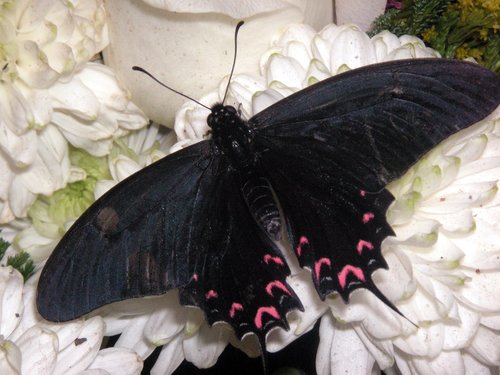
Scientific name: Mimoides thymbraeus (Boisduval, 1836), originally described in Seitz as Papilio thymbraeus. This butterfly has small grey-yellow spots on its head and breast, which are often slightly reddish. The upperside of its wings has a faint but distinct metallic blue or green sheen; the forewing has no markings, but has white fringes, while the hindwing has a slender tail and 1 or 2 rows of spots between the cell and the wing margin. On the underside, the forewing has a red basal spot along the costa, and the hindwing has 4 basal spots. Its larva feeds on Chirimoya. The larva's thorax is dotted with blue and yellow; starting from the 4th abdominal segment, the body is striped with white and black, the white stripes bear small blue and yellow spots, and the sides are blue, with yellow dots appearing starting from the 5th segment. The pupa is green, similar to pupas of related species, and looks constricted at the base of the abdomen. Adult butterflies fly throughout the whole year in open country, and are fairly common at elevations between 500 and 1560 meters. The nominate subspecies, Mimoides thymbraeus thymbraeus (thymbraeus Boisd. [14 b]), ranges from eastern Mexico to Honduras, and both males and females have 2 rows of red spots on the hindwing. The subspecies Mimoides thymbraeus aconophos (aconophos Gray) has only one row of red spots on the hindwing, as the discal row is missing, and it occurs in central and western Mexico.