About Mimoides lysithous (Hübner, 1821)
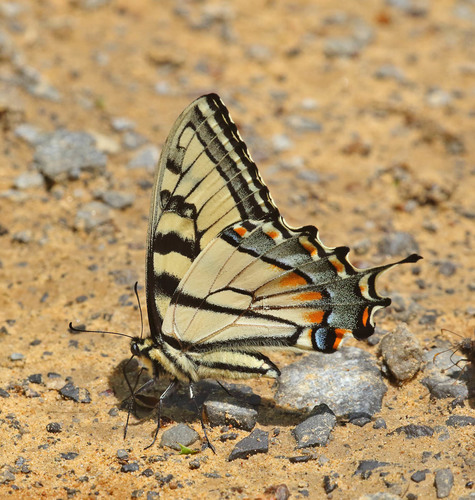
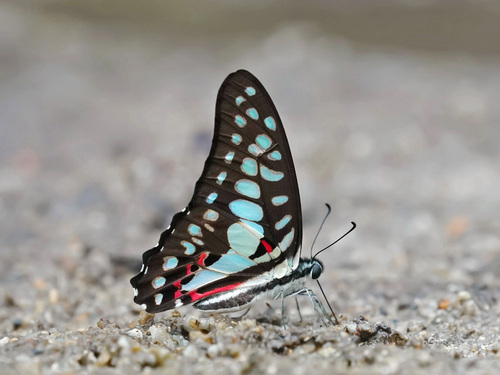
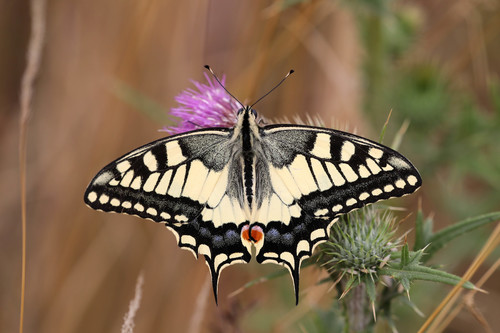
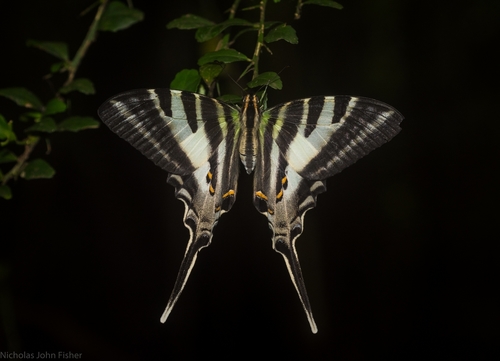
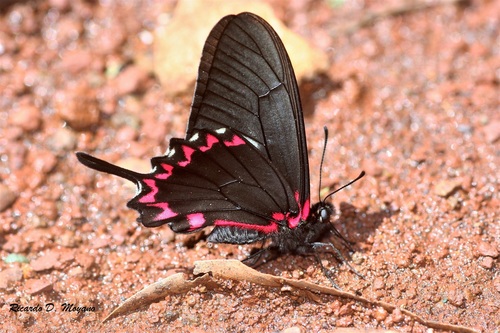
This species, scientifically known as Mimoides lysithous (Hübner, 1821), is a polychromatic butterfly species. With one exception, its different individual forms were originally described as separate species and were treated as such until recent times. All forms are connected to one another via intergradations, and breeding experiments have confirmed the specific identity of three varieties: pomponius, rurik, and lysithous. All forms of this species have a tail. On the underside of the forewing, there are 2 red basal spots, and the hindwing has 3 red basal spots. The larva feeds on Anona. It rests during the day on the upper leaf surface along the central vein, found on lower branches and root-shoots. Near Petropolis, larvae are present year-round except for June and July, the middle of the dry season. Mature larvae are black with yellow longitudinal stripes and a white-yellow saddle-shaped spot. Like the pupae of closely related species, the pupa of this species is green with a yellow lateral streak. Mimoides lysithous is distributed in Brazil and Eastern Paraguay. Its principal forms do not co-occur in all regions, and are outlined below: f. platydesma R. & J. (= harrisianus auctt., 14b) has a very broad white band on the forewing, which continues across the cell to the costal margin. f. harrisianus Swains. (= claudius Boisd.; athous Fldr.) has a forewing white band that is broad posteriorly, strongly narrowed anteriorly, and does not enter the cell; the portion of the band from the lower angle of the cell to the costal margin is either narrow or entirely absent, and the posterior submarginal spots of the hindwing are large, matching the preceding form. f. oedipus Fldr. (= sebastianus Oberth., 14a) has a double spot on the forewing starting from the first median vein backward, and the hindwing has no white band, with the 4 posterior submarginal spots large. f. lysithous Hbn. (14a) has a narrow forewing band that is often abbreviated (ab. brevifasciatus Weym.). The hindwing has small submarginal spots, and the band usually only extends to the first median vein, and is sometimes longer and positioned more distally (ab. extendatus f. rurik Eschsch. (= rurikia id. in tab., laius Boisd.) has an abbreviated forewing band, no white band on the hindwing, and rather large 4 posterior submarginal spots. f. pomponius Hopff. has either an indicated forewing band, or no band at all, matching the complete absence of a band on the hindwing. f. eupatorion Luc. has no discal band on either wing, a yellowish marginal band on the forewing, and enlarged marginal spots on the hindwing; this form is probably an aberration, and only the type specimen is known, held in the collection of Charles Oberthur.