About Mimetes fimbriifolius Knight
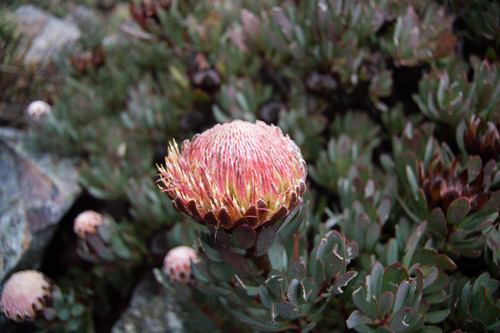
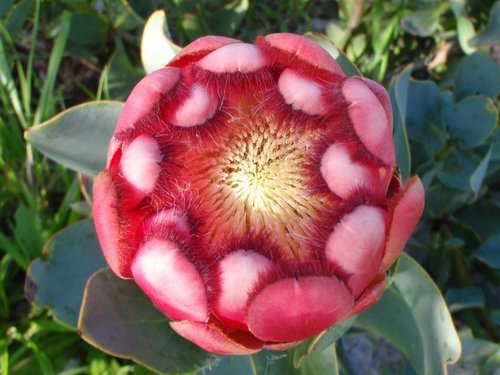
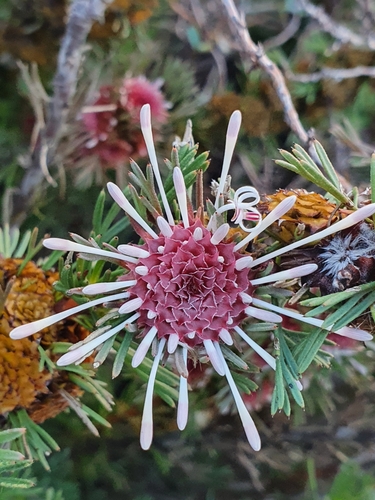
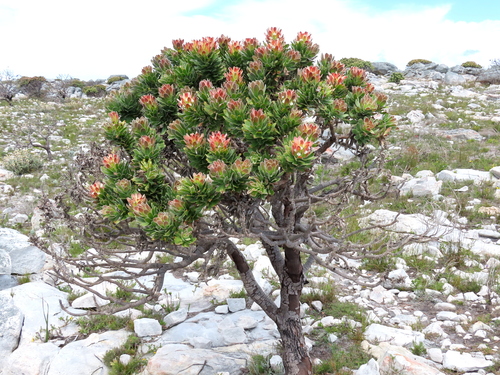
Mimetes fimbriifolius, commonly called tree pagoda, is a small tree that reaches 2½–5 m (8–16 ft) in height, and can grow a crown up to approximately 5 m across. It grows from a stout trunk 25–60 cm (0.8–2.0 ft) thick, covered in up to 2½ cm (1 in) thick, irregularly fissured grey bark that protects the plant from fire. Stocky stems 1–1¼ cm (0.4–0.5 in) thick grow from the trunk, branching regularly; these stems are initially covered in grey felty hairs that gradually wear away as the plant ages. Leaves are arranged alternately along the branches, point upward and overlap one another. They have an oblong, elliptic, or oblong overall outline, measuring 4–7 cm (1.6–2.8 in) long and 1¼–2¼ cm (0.4–0.9 in) wide. Leaves are abruptly truncated at the base, lack a leaf stalk, and have a blunt tip with three closely clustered thickened teeth. The rest of the leaf margin is smooth except for a row of evenly spaced hairs along its entire length. Leaf surfaces are initially densely covered in felty hairs, which wear off over time. The scarlet leaves that subtend the flower heads are fiddle-shaped with downward curving sides, forming a hood that covers the flower head below on the stem. Inflorescences are broad cylinder-shaped, 6–8 cm (2.4–3.2 in) long and 6–7 cm (2.4–2.8 in) in diameter. Flower heads, which form in the axils of upper leaves on the stems, each contain 4 to 7 individual flowers. Bracts that encircle the flower heads differ in size, neatly clasp the base of the flowers, have a powdery hair covering that becomes felty near the base, and together form a two-lipped involucre. The two or three bracts located below the point where flowers attach are broadly elliptical with a pointed tip, and are larger, measuring 3½–4 cm (1.4–1.6 in) long and 12–16 mm (0.48–0.64 in) wide. Bracts above the point of flower attachment are smaller, narrowly lance-shaped with a pointed tip, and measure 1½–2½ cm (0.6–1.0 in) long and 3–5 mm (0.12–0.20 in) wide. The bract that subtends each individual flower ranges from linear to awl-shaped, is about 10 mm (0.40 in) long and 1 mm (0.04 in) wide, and is densely covered in silky hairs. The 4-merous perianth is 4–4½ cm (1.6–1.8 in) long. Its lower segment, which stays merged when the flower opens, is opaque, hairless, inflated, and around 3 mm (0.12 in) long. The four middle segments (claws) are line-shaped and covered in powdery hairs. The upper segments (limbs), which enclose the pollen presenter when the flower is a bud, are boat-shaped with a pointed tip and have a felty outer surface. A style 5½–6 cm (2.2–2.4 in) long emerges from the center of the perianth. The thickened tip of the style, called the pollen presenter, is narrowly elliptical with a pointed tip, 8–10 mm (0.32–0.40 in) long, and has a ring-shaped thickening at its base, with a skewed sigmatic groove. The oval ovary is covered in silky hairs, 1–2 mm (0.04–0.08 in) long, and hard to distinguish from the style. It is subtended by four fleshy, awl-shaped scales around 1½ mm (0.06 in) long. The one-seeded fruits are broadly egg-shaped, around 8 mm (0.32 in) long and 5 mm (0.20 in) wide. This endemic species is native to the Cape Peninsula, ranging from Cape Point northward to Table Mountain. While it mostly occurs above 300 m (1000 ft) at its northern range limit, it grows down to sea level in the southern part of its range. It prefers rocky slopes, and the largest, best-formed specimens grow on rocky outcrops, where they are protected from the full force of the wildfires that frequent fynbos habitats. Large specimens were once very common on Table Mountain, but firewood harvesting and the spread of invasive alien plants have eliminated the species from much of its former range there. Mimetes fimbriifolius is the largest and longest-lived species in the genus Mimetes. Its exceptionally fire-resistant bark allows it to survive the seasonal fires that naturally occur across all fynbos vegetation.