About Mimetes cucullatus (L.) R.Br.
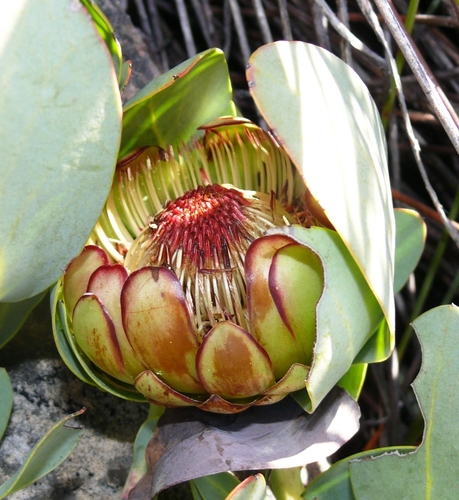
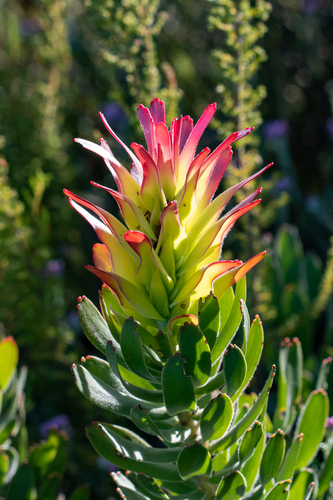
Mimetes cucullatus (L.) R.Br. is an evergreen, upright shrub that reaches 1–2 m (3–7 ft) in height. It grows from a firm woody tuber buried in the ground, which produces several upright stems. These stems are 3–8 mm (0.12–0.32 in) thick, mostly unbranched but occasionally forked, and are initially covered in grey felty hair that typically wears away as the plant ages. Leaves are arranged alternately along the stems, and range from very narrow to broadly elliptic or inverted egg-shaped, measuring 2½–5½ cm (1–2¼ in) long and ½–2 cm (0.2–0.8 in) wide. New young growth is scarlet, fading to green further down the stem. The leaves that subtend the flower heads are inverted fiddle-shaped in outline, folded backwards from the midline, and are scarlet in their upper sections during flowering, gradually shifting through yellowish to green at the base; some individuals are entirely yellowish with a green base, or soft orange. The overall inflorescence, made up of many individual flower heads in the axils of the highest leaves on the stem, is cylindric, 6–10 cm (2½–4 in) long and 4–7 cm (1⅔–2 in) in diameter. It is topped by a tuft of small, more or less upright, narrowly egg-shaped, scarlet leaves. Each individual flower head holds four to seven flowers, and is subtended by a fiddle-shaped leaf that bends away from the stem to cowl over the flower head below it. These subtending leaves are mostly scarlet with some yellow and green at the very base, more rarely entirely yellow with a green base, and intermediate soft orange forms also occur within the same populations. The margins of these leaves are either entire, or have three teeth near the tip. The bracts that encircle each flower head are unequal in size, neatly clasp the base of the flowers, have a fringe of silky hairs, and together form a two-lipped involucre. Bracts below the point of flower attachment are ellipse-shaped with a pointed tip, larger, measuring 1½–3 cm (0.6–1.2 in) long and 3–12 mm (0.12–0.48 in) wide. Bracts above the point of flower attachment are smaller, lance-shaped with a pointed tip, 8–10 mm (0.32–0.40 in) long and 1½–3 mm (0.06–0.12 in) wide. The bract that subtends each individual flower is linear with a pointed tip to awl-shaped, 6–10 mm (0.24–0.40 in) long. The 4-merous perianth is 3½–4 cm (1.4–1.6 in) long and curved in bud. The lower part of the perianth, which remains merged when the flower opens, is hairless, inflated, and about 1 mm (0.04 in) long. The middle sections (claws) are each about 10 mm (0.4 in) long, line-shaped, and covered in powdery to thinly silky hair. The upper sections (limbs), which enclose the pollen presenter in bud, are line-shaped with a pointed tip, hard to distinguish from the claws, and covered in dense silky hair. A style 4½–5 cm (1.8–2.0 in) long emerges from the center of the perianth. The thickened tip of the style, called the pollen presenter, is line to awl-shaped, 5–7 mm (0.20–0.28 in) long, with a ring-shaped thickening at its base, a sharply pointed tip, and the sigmatic groove across its middle. The oval ovary is covered in dense silky hair, about 1 mm (0.04 in) long, and is subtended by four fleshy awl-shaped scales. Mimetes cucullatus is the most widely distributed pagoda species, found from west of the Olifants River valley near Porterville in the north and the Cape Peninsula in the southwest, east to the Langeberg range. It is particularly common along the coast between Hangklip near Pringle Bay in the Kogelberg area to Bredasdorp. There are three isolated inland populations of M. cucullatus in the Kouga Mountains, Klein Swartberg and Rooiberg, an isolated mountain in the middle of the Little Karoo. Another isolated population occurs on the Potberg. This distribution pattern suggests its original range was larger than today, and it has become restricted to areas that receive enough rainfall as drought has increased. This plant is a resprouter, meaning it grows new shoots from its base after a fire. This trait is unusual in the genus Mimetes, as all other Mimetes species are re-seeders: their seeds germinate after a fire, but mature plants are killed by fire. M. cucullatus has proteoid (cluster) roots, which improve nutrient uptake and allow the plant to grow in low-nutrient soils. Like other members of the genus Mimetes, this species is adapted to bird pollination. Mimetes cucullatus has special glands called extrafloral nectaries on the tips of its leaves, which attract ants. Ants may protect the plant against insect herbivores. Ants are also the main dispersers of M. cucullatus seeds. Mimetes cucullatus is an unusual and beautiful plant. It is popular with gardeners interested in indigenous plants and wildlife gardens. Because M. cucullatus is a resprouter, it responds well to severe pruning, which makes it well suited for use as a cut-flower.