About Mimetes chrysanthus Rourke
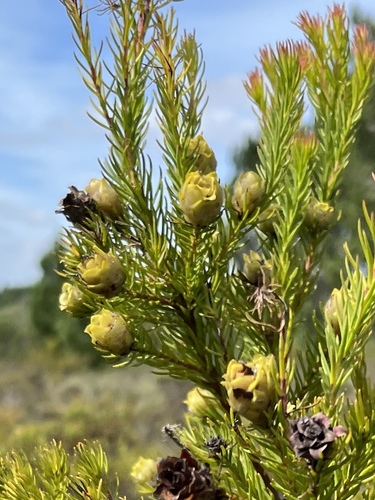
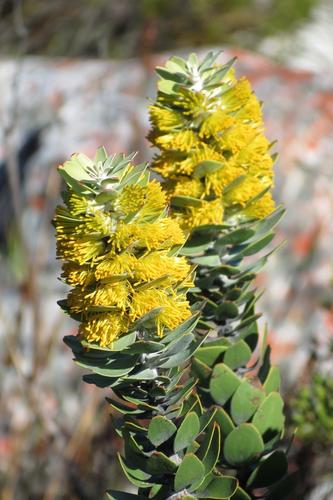
Mimetes chrysanthus is an evergreen, upright, sparsely branched shrub that reaches 1½–2 m (5–6½ ft) in height, with a single main trunk 4–6 cm (1⅔–2⅓ in) thick at its base. Stiff, upright branches around 2 cm (¾ in) thick grow from this trunk, and are covered in smooth grey bark. Flowering branches are 4–7 mm (0.16–0.28 in) thick, covered in a dense layer of minute, powdery crisped hairs. Leaves are arranged alternately along the branches, do not have stipules, and narrow at their base into a 3–5 mm (0.12–0.20 in) long stalk. The leaf blade is broadly lance-shaped to elliptic, 3–4½ cm (1.2–1.8 in) long and 1–1¾ cm (0.4–0.7 in) wide. Young leaves have some minute, powdery crisped hairs that wear off over time. The leaf margin is entire, and the thickened leaf tip is notched or slightly split in two. The inflorescence is made up of 50 to 70 crowded flower heads, each positioned in the axil of a leaf, which together form a cylinder 6–9 cm (2.4–3.6 in) long and 5½–6 cm (2.2–2.4 in) wide. The top of the cylinder is capped by a crest of more or less upright, small green leaves. Each flower head sits in the axil of a plain green leaf that extends horizontally outward. A single flower head can hold up to 25–35 individual flowers, with flower heads lower on the inflorescence usually containing the fewest flowers. Bracts that surround each flower head overlap tightly. Outer whorl bracts are oval with a blunt tip, becoming slightly spade-shaped with age, 5–10 mm (0.2–0.4 in) long and 2–3 mm (0.08–0.12 in) wide. They are covered in dense woolly hairs at the base, and are rounded, thickened, and eventually hairless at the tip. Inner whorl bracts are 6–8 mm (¼–⅓ in) long and 1–1½ mm (0.04–0.06 in) wide, lance-shaped with a pointed tip, covered in dense silky hairs, and cartilaginous in texture. After fertilization, they grow to three to four times their original size and become woody. The bract that subtends each individual flower is line-shaped with a pointed tip, ¾–1¼ cm long, covered in silky hairs, and has a tuft of longer straight hairs at the tip. The 4-merous perianth is bright yellow, 2½–2¾ cm (1.0–1.1 in) long, straight when in bud, and curves toward the stem when the flower opens, but becomes star-symmetrical after opening. Unlike other species in the Mimetes genus, this flower does not have a tube at its base. The lower perianth segments are ¾–1 cm (0.3–0.4 in) long, hyaline in texture, hairless, free, and bent outward. The middle part of the perianth forms a tube (because segments are joined by interlocking hairs along their margins) that is 6–8 mm (¼–⅓ in) long and covered in dense powdery hairs. The upper perianth segments (or limbs), which enclose the pollen presenter when in bud, are hairless, line-shaped with a pointed tip, and 3–5 mm (0.12–0.20 in) long. A straight, yellow, thread-shaped style 2½–3½ cm (1.0–1.4 in) long emerges from the center of the perianth. The thickened tip of the style, called the pollen presenter, is 1–1¼ mm (0.04–0.06 in) long, line-shaped, and has a slight narrow point where it connects to the style. The stigma, which is a groove that functions as the receptive part for pollen, is positioned symmetrically across the very tip of the pollen presenter. The cylindrical ovary is 2 mm (0.08 in) long, covered in powdery hairs, and difficult to distinguish from the style. It is subtended by four awl-shaped scales 1–1½ mm (0.04–0.06 in) long. The ovary develops into an egg-shaped to cylindrical, indehiscent, one-seeded fruit that is 6–8 mm (¼–⅓ in) long and 4–5 mm (0.16–0.20 in) wide. The fruit is covered in minute powdery hairs, and becomes hairless over time. The flowers of Mimetes chrysanthus are sweetly scented. Mimetes chrysanthus, commonly called the golden pagoda, is only known from two locations. The first location, where the species was discovered, is on the Gamkaberg, at the edge of the Little Karoo; the second is on the Perdeberg near Herold. On Gamkaberg, it grows on steep, well-drained, nutrient-poor sandy slopes that face summer winds which bring some rain and mist. Most precipitation in this area falls during winter, with an average annual precipitation of 400–450 mm (15–18 in). It occurs at an altitude of 800–1040 m (2625–3415 ft) in several types of Sandstone Fynbos, particularly Outiniqua Sandstone Fynbos, South Rooiberg Sandstone Fynbos, and North Rooiberg Sandstone Fynbos. Flowers are visited by carpenter bees (such as Xylocopa capensis), orange-breasted sunbirds, and Cape sugarbirds, and produce large amounts of nectar. It is thought that bees are mostly responsible for pollination, since the flowers are yellow, a color most attractive to bees, while birds generally prefer red. Fruits, which are protected by enlarged woody bracts, take around eight months to mature, and fall to the ground around December. After falling, ants collect the fruits and carry them to their underground nests.