About Mimetes capitulatus R.Br.
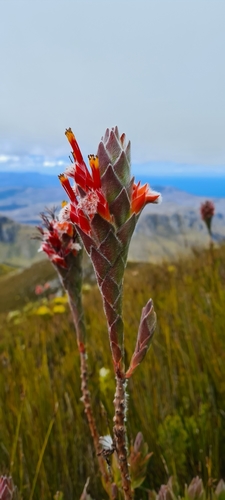
Mimetes capitulatus R.Br. is an evergreen, rounded shrub reaching about 2 m (7 ft) tall, growing from a single trunk and forming a densely branched crown. Older plants also develop several typically unbranched straggling shoots. Branches are 5–8 mm (0.20–0.32 in) thick, initially covered in greyish felty hairs that wear away over time. Leaves are arranged alternately along branches, slightly overlapping and angled upward. They lack stipules and leaf stalks, are lance-shaped to egg-shaped in outline, 2–3.5 cm (0.8–1.4 in) long and ¾–2 cm (0.3–0.8 in) wide, with an entire margin that ends in a sharp, thickened point. Their surface is initially covered in rough felty hairs, which are eventually lost. Inflorescences are broadly cylindrical, 6–10 cm (2.3–4 in) long and 6–8 cm (2.3–3.3 in) in diameter, topped with more or less upright leaves similar in appearance to the plant’s other leaves. Flower heads, each holding 10 to 13 flowers (most often 11), grow in the axils of upper leaves. The bracts subtending these flower heads are broadly oval, 2.5–4 cm (1–1¾ in) long and 1.5–2 cm (0.7–0.8 in) broad, covered in rough hairs with a row of rough hairs along the margin, and are sometimes flushed reddish. The outer whorl of bracts surrounding each flower head is upright, softly hairy, greenish-white flushed with red, and very narrowly lance-shaped to linear, 1.5–2.5 cm (0.6–1.0 in) long and 3–6 mm (0.12–0.24 in) wide. The inner whorl of bracts is lance-shaped to narrowly lance-shaped, with a sharply pointed tip, 1.5–4 cm long and 0.8–1.5 cm (0.3–0.7 in) wide, orange to red in colour, with a hyaline texture, hairless towards the tip and powdery hairy towards the base. The bract subtending each individual flower is orange to red, narrowly lance-shaped with a pointed tip, 3–3.5 cm (about 1¼ in) long and about 0.5–1 cm (0.3 in) wide, hairless at the base and powdery hairy towards the tip, with a row of hairs along the edge. The 4-merous perianth is 3–4 cm (1.2–1.6 in) long. Its lower part, which remains fused when the flower opens, is slightly inflated, hairless at the base, and about 5–7 mm (0.20–0.28 in) long. The middle segments (claws) are thread-shaped and covered in silky hairs. The upper segments (limbs), which enclose the pollen presenter while in bud, are linear with a pointed tip and covered in dense silky hairs. Anthers are fused directly to the limbs, lack filaments, and are about 4 mm (0.16 in) long. Emerging from the center of the perianth is a 4.5–5.5 cm (1.8–2.2 in) long style that grows and curves when the flower opens, then straightens as it matures. The style is scarlet with yellow colouring near its tip. The thickened tip of the style, called the pollen presenter, is 5–7 mm (0.2–0.3 in) long, shaped like a narrow hourglass, with a thickened ring at the base, a narrow middle section, and a cone- to head-shaped tip that holds the sigmatic groove across its center. The ovary is covered in silky hairs and about 2 mm (0.08 in) long, subtended by four fleshy, blunt linear scales around 2 mm (0.08 in) long. The fruit is powdery hairy, cylindrical, 5–6 mm (0.20–0.24 in) long and 2–3 mm (0.08–0.12 in) in diameter. This species, commonly called conical pagoda, has five known populations located in the Kogelberg, Kleinrivier, and Groenland Mountains, which are coastal or near-coastal mountain ranges, at altitudes between 600–1200 m (2000–4000 ft). Average annual precipitation here is around 1500 mm (60 in), with most rain falling during the southern winter. It grows on permanently moist, occasionally swampy peaty soils, near ridges or peaks on cool southeastern slopes, in vegetation that also includes the restionid Elegia mucronata, Klattia partita, and the bruniaceous species Berzelia ecklonii and Brunia alopecuroides. In these sites, cloud condensation produces additional precipitation during the normally dry summer months. Mimetes capitulatus is pollinated by birds, most commonly the malachite sunbird (Nectarinia famosa), southern double-collared sunbird (Cinnyris chalybeus), and orange-breasted sunbird (Anthobaphes violacea). It flowers from mid-June to November, peaking in August, and produces large amounts of nectar. Fruits ripen individually 2 to 6 months after flowering, then fall to the ground. Native ants collect the fallen fruits and carry them to their underground nests, where the elaiosome (ant bread) is eaten, leaving the seeds protected underground. Seeds germinate after an overhead wildfire, and mature plants do not survive fires.