About Mimachlamys varia (Linnaeus, 1758)
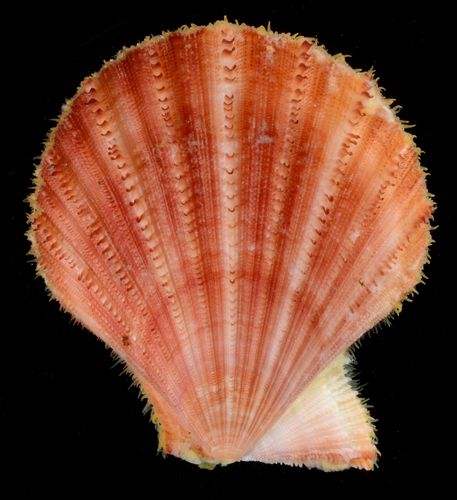
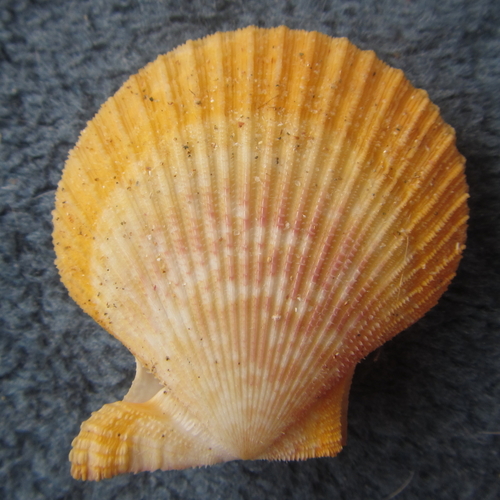
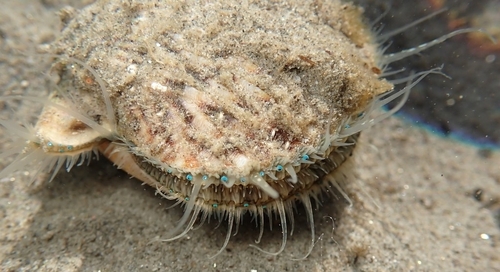
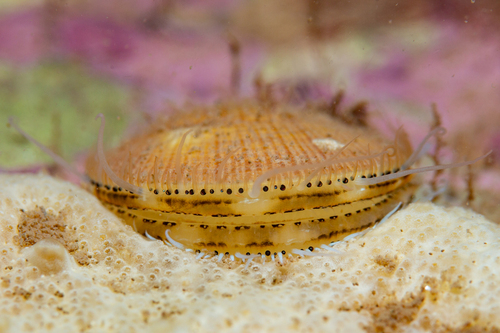
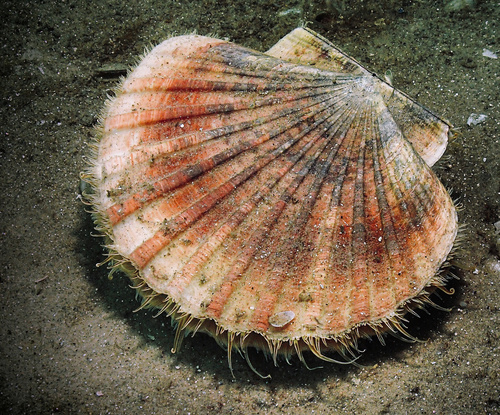
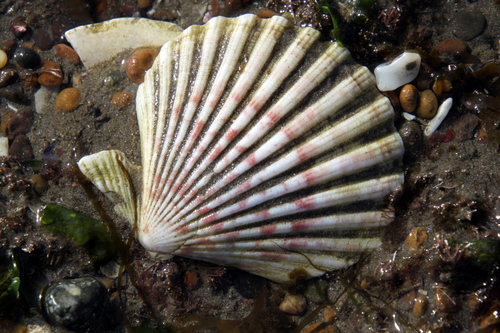
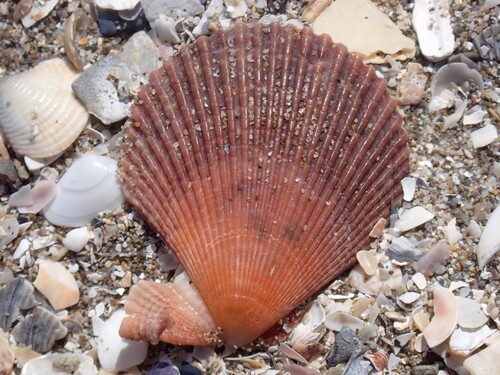
The shell of Mimachlamys varia displays a range of colors and variegated patterns, including white, pink, red, orange, yellow, purple, and any intermediate shade between these. Both valves are convex, rounded or oval, and symmetrical, with the exception of the auricles (ears) on either side of the umbo. The shell is solid, inequivalve (valves differ in size) and inequilateral (symmetry is unequal along the hinge axis). Twenty-five to 35 ribs radiate from the umbo, and these ribs bear spatulate spines that are most distinct near the shell margin. Fine concentric lines sculpt the valves, and these lines mark annual growth rings. The anterior ear is significantly longer than the posterior ear. The right anterior ear has a notch that holds the byssus, the structure that anchors the shell in place, and small teeth along its lower edge. The inner surface of the shell is glossy, and often matches the color of the exterior. The shell usually does not grow longer than 6 cm (2.4 in). This scallop species occurs in the North Sea, English Channel, Atlantic Ocean, and Mediterranean Sea. Mimachlamys varia is a shallow-water species that lives at depths up to around 100 m along coastal rocky areas. It is typically found under boulders or within the holdfasts of seaweeds. It occurs in sheltered habitats in Strangford Lough, Northern Ireland, and is listed as a Northern Ireland Priority Species due to its rapid population decline there. Like other scallops, Mimachlamys varia is a filter feeder: it draws water through its gills and removes small edible particles from the water. It changes sex multiple times over its development, and becomes male when it reaches full maturity. Young individuals are attached to substrate via byssus threads, while older individuals may become detached. It is commonly overgrown by the holdfasts of the seaweeds it lives among, and sponges such as Halichondria panicea may also grow on its shell.