About Millepora platyphylla Hemprich & Ehrenberg, 1834
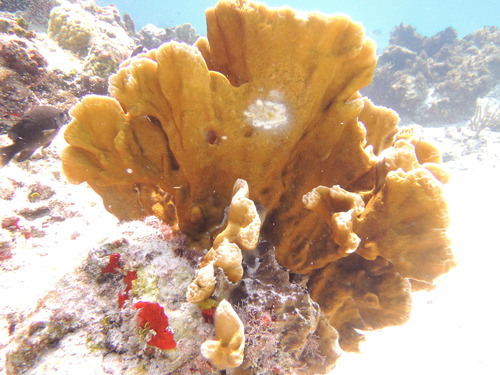
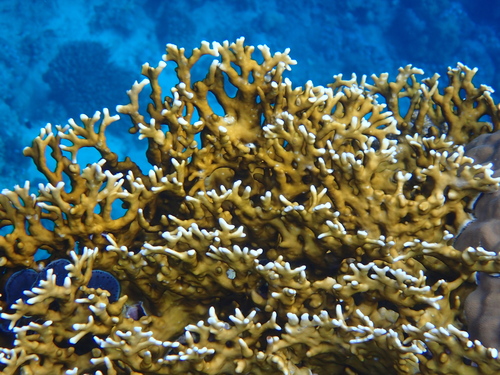
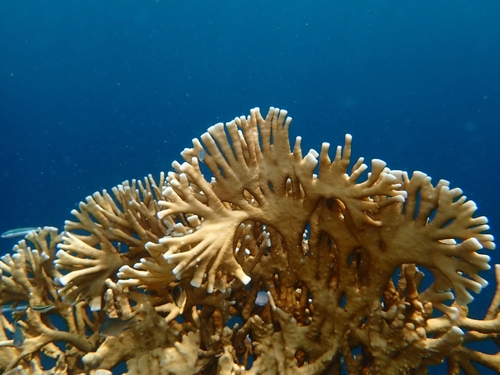
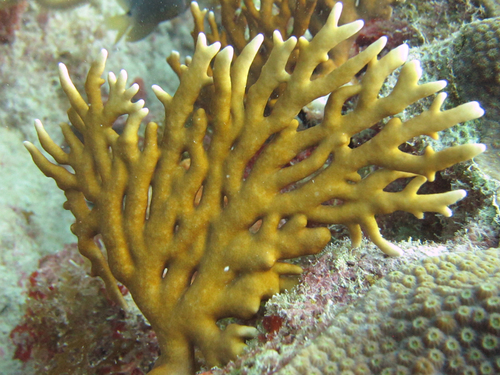
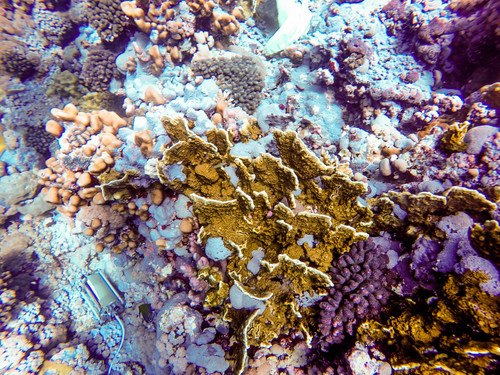
Millepora platyphylla belongs to the class Hydrozoa, so it is not a true coral unlike the stony and soft corals that fall in the class Anthozoa. Like all other fire coral species, M. platyphylla can grow into a variety of forms including branches, fans, plates, blades, or encrusting forms. It is generally characterized by a plate-like or blade-like growth form, which sets it apart from other Millepora species such as Millepora dichotoma and Millepora exaesa. The morphology of this species changes depending on the habitat it occupies. Encrusting forms are better adapted to resist high wave activity, and exposed sheet tree forms can take advantage of breaking waves to help the coral reproduce through fragmentation. Like other reef-building corals, M. platyphylla forms colonies and has stinging cells called nematocysts. These stinging cells give fire corals their common name, because touching the coral causes a burning sensation in humans. M. platyphylla has two types of specialized polyps: gastrozooids for feeding and dactylozooids for defense. Gastrozooids have a ring of short tentacles surrounding an oral cavity. Dactylozooids do not have an oral cavity, and instead have longer tentacles that they use for defense. The two polyp types are housed respectively in structures called gastropores and dactylopores, which are arranged into cyclosystems. This species has gonophores that act as its reproductive organs. Colonies of M. platyphylla vary widely in size, but most often reach diameters between 200 and 300 centimeters, and can grow up to 200 centimeters in height. This coral can be yellow-green or light brown in color, and its growth tips are often white. Millepora platyphylla has a broader geographic range than many other Millepora species, such as Millepora latifolia and Millepora tenera. It is commonly found across the Indo-Pacific, including the Red Sea and French Polynesia, and has been studied by researchers in Indonesia, Egypt, and Moorea, French Polynesia. After major bleaching events, M. platyphylla was thought to have been extirpated from the Eastern Pacific, but researchers have recently confirmed the species has returned to this region. The species inhabits shallow reef crest areas, typically occurring at depths below 5 meters, but can be found at depths up to 10 meters. It also lives in the surf zone and spur and groove zone at depths up to 10 meters, in habitats that experience frequent strong wave action.