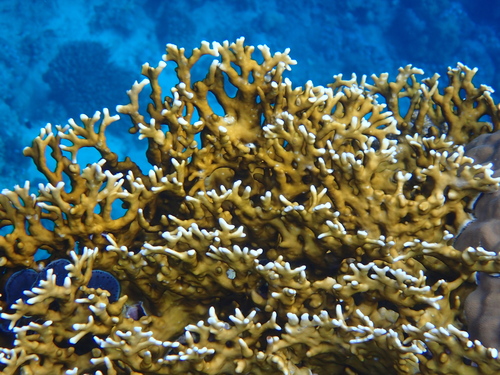
About Millepora dichotoma Forsskål, 1775
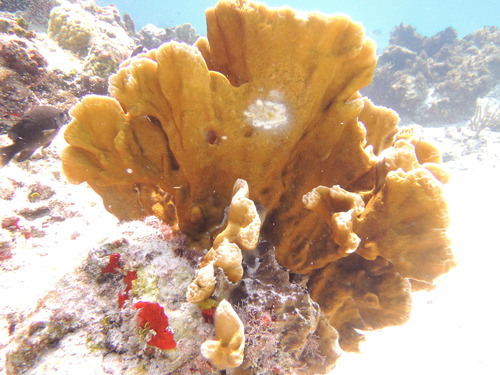
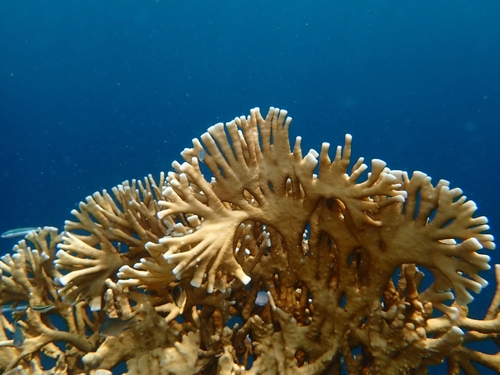
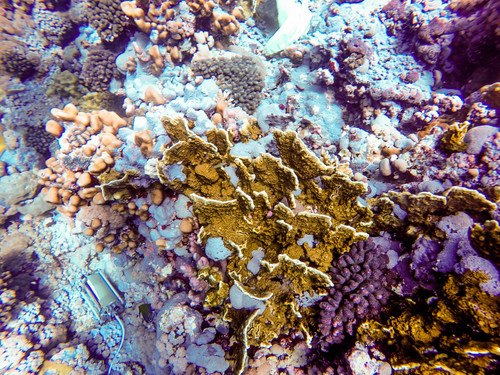
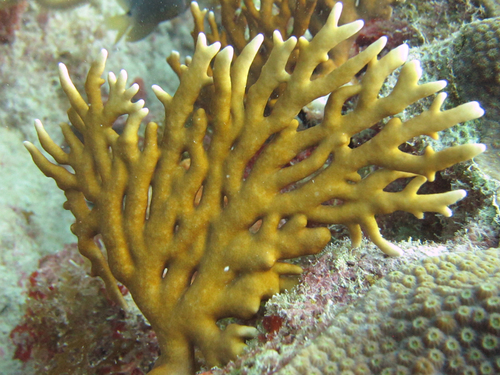
Millepora dichotoma is a colonial hermatypic coral that forms a calcareous endoskeleton. Individual colonies can grow up to 60 cm wide, while connected clumps of multiple colonies may reach several meters across. New colonies begin as encrusting growth that adheres to hard substrates. These encrusting formations later develop into other growth forms, including lace-like structures, leaf-like blades, and box-work. The specific growth form an individual colony develops depends heavily on the growth depth, growth location, and local water turbidity. More fragile growth forms such as lace-like structures survive better in deeper, less turbulent water, while box-work forms thrive better in harsher environments. Like other hermatypic fire corals, M. dichotoma relies on symbiotic zooxanthellae for part of its metabolism. These symbiotic zooxanthellae give M. dichotoma its vibrant colors, support the coral’s structural growth, and assist with nutrient cycling. M. dichotoma belongs to phylum Cnidaria, so it produces nematocysts. The nematocysts of M. dichotoma carry venom that is fatal to many organisms, though it has not been recorded as fatal to humans. For humans, contact with M. dichotoma venom can cause extreme pain, burn-like wounds, and skin irritation that may last up to two weeks. M. dichotoma is found in the Republic of Mauritius, the Red Sea, and the Indo-West Pacific region. It is a benthic species, most commonly found at depths between 0.2 and 3 meters. The reproduction season of M. dichotoma runs from April to May, though gametes may still be present through June. This species reproduces via synchronized gamete release that enables external fertilization. Male gametes are released slightly before females release their eggs to increase fertilization success. Multiple separate gamete release events occur throughout the multi-month reproduction period. After fertilization, gametes disperse via ocean currents, then eventually settle on the seafloor to establish new colonies or add to existing ones. After a planktonic stage, polyps settle and adhere to hard substrates, become hosts to symbiotic zooxanthellae, and begin building their calcareous skeletons.