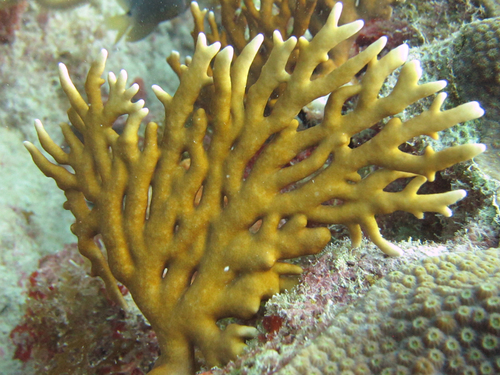
About Millepora alcicornis Linnaeus, 1758
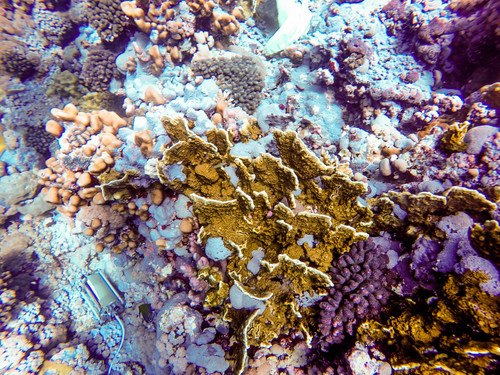
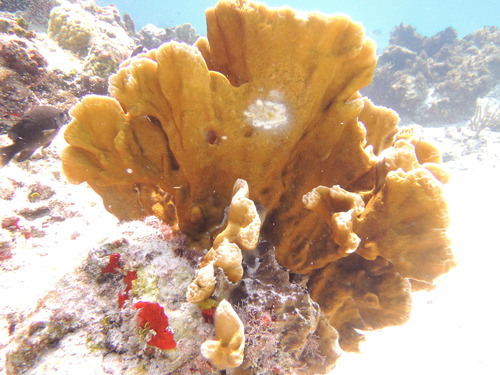
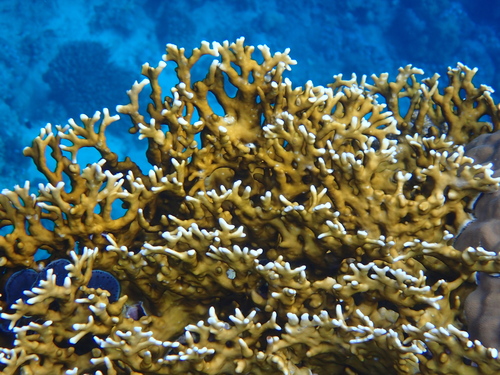
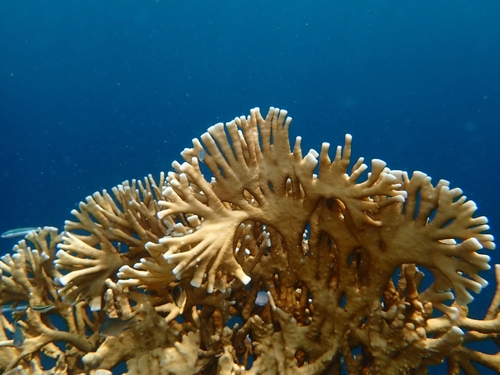
Millepora alcicornis Linnaeus, 1758, commonly known as fire coral, has highly variable morphology. Most colonies begin as encrusting forms that develop a branching structure as they grow. These encrustations can establish on a wide range of structures, including coral reefs, rocks, dead corals, and the hulls of wrecked ships. Later growth forms depend on habitat water movement: in high-movement habitats such as the surf-exposed outer edges of reefs, colonies develop into plates or blades. In calmer waters, such as deep lagoons or more sheltered parts of reefs, colonies develop a more upright, leafy or branched structure that can reach 50 centimetres (20 inches) tall. Growth habit is also influenced by the inclination of the surface the fire coral grows on. On vertical surfaces, encrusting bases are larger with longer perimeters, and branching density is lower than on horizontal surfaces. The cylindrical branches of Millepora alcicornis usually grow in a single plane, and range in color from brown to pale cream-like yellow, with white branch tips. Numerous microscopic polyps are embedded in the species' calcareous skeleton. The polyps are connected internally by a system of canals, and are hidden behind pores in the skeleton. The skeleton surface is smooth, and lacks the corallites found in true stony corals. The polyps have specialized functions: gastrozooids process and digest food caught by dactylozooids, which are grouped around the gastrozooids. Gastrozooids are small and plump, and extend four to six short tentacle stubs through their pores, but are otherwise not visible externally. Dactylozooids have hair-like tentacles covered in cnidoblasts. Stings from cnidocysts immobilize prey items, then the tentacles push the prey through the mouth of an adjacent gastrozooid, where it moves into the stomach for digestion. The polyps also extrude coenosteum, the calcareous material that forms the species' skeleton. Coenosteum contains symbiotic photosynthetic microalgae called zooxanthellae. These algae provide their host fire coral with energy, and in return receive a protective environment in a well-lit location. Zooxanthellae supply approximately 75% of the fire coral's total energy requirements. Millepora alcicornis is native to the Caribbean Sea, the Gulf of Mexico, Florida, the Cape Verde Islands, and the coast of Central and South America as far south as Brazil. More recently, colonies have also been recorded in the Canary Islands and on the island of Madeira. The species has also been found in Bermuda, but its morphology at this location is so different from the rest of its range that the Bermuda population may represent a distinct species. It grows at depths of up to 40 metres (130 feet), and is the only fire coral that often grows at depths greater than 10 metres (33 feet). A number of shrimp and fish species take shelter among the branches of Millepora alcicornis, and appear to be immune to the species' venom. Hawkfish in particular frequently perch on top of this fire coral, possibly protected by their skinless pectoral fins. Unsurprisingly, Millepora alcicornis has very few predators. The fireworm Hermodice carunculata sometimes grazes on it, though it prefers other corals. Certain nudibranchs in the genus Phyllidia and filefish in the family Monacanthidae eat Millepora alcicornis. When Millepora alcicornis grows in close proximity to an arborescent gorgonian sea fan, the fire coral becomes aggressive. It produces specialized "attack" branches that grow sideways toward the sea fan, develop into hand-like structures, then encircle and smother the sea fan. The fire coral then uses the smothered sea fan as a substrate for new growth. Sometimes this new growth separates from the parent colony, forming a new genetically identical fire coral colony. This aggressive behavior is specific to gorgonians, and does not occur in response to the close presence of other live or dead corals, other sessile invertebrates, or open water. The fire coral appears able to detect the gorgonian's presence due to water flowing over the surfaces of both organisms.