About Milax gagates (Draparnaud, 1801)
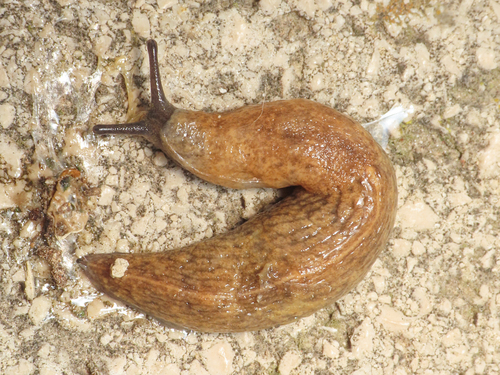
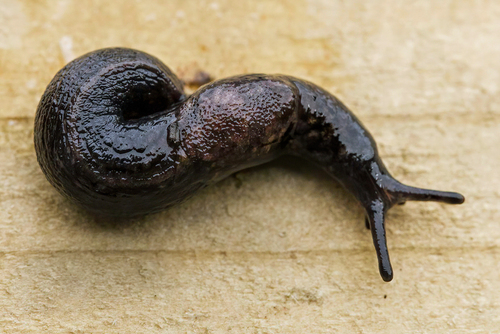
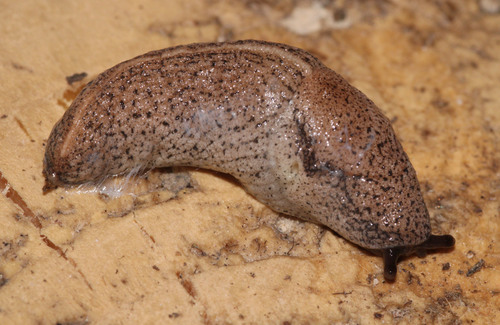
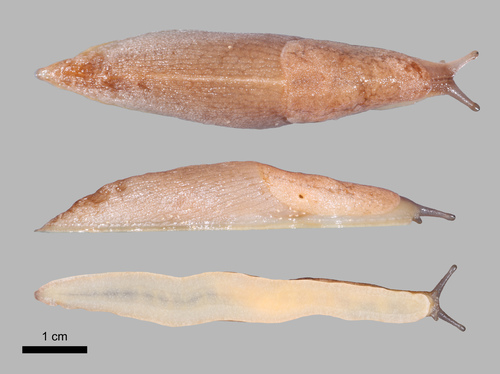
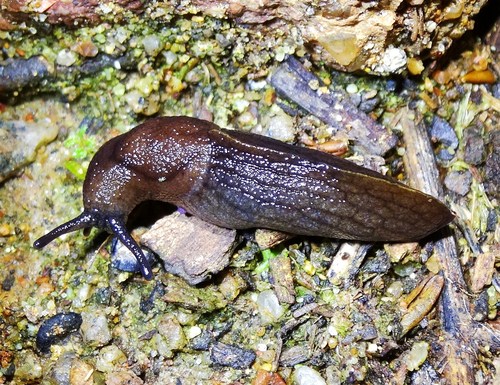
Milax gagates, described by Draparnaud in 1801, has an even dark grey to black body with somewhat lighter sides, and no pigment spots. Its mantle is relatively large, covering 35-40% of total body length, and has distinct grooves. A prominent keel runs between the mantle and the posterior end of the body. Its skin sculpture is weak, with 16-17 grooves between the keel and the pneumostome. The foot sole has blackish lateral zones and a lighter medial zone. Live adult Milax gagates can reach up to 50 mm in length; preserved specimens measure 25–30 mm in length and 6–8 mm in width. Adult slugs weigh between 991.2 mg and 3308.0 mg.
In its reproductive system, the penis is rounded, and half as long as the epiphallus. The epiphallus is slightly widened and truncated at its end, appearing as if cut off. The vas deferens is short, usually no longer than the epiphallus, and opens asymmetrically at the truncated end of the epiphallus. The atrium is short and not widened. The accessory gland is made up of several elongate glands, and connects to the atrium via around 20 short coiled tubular ducts. The stimulator is narrow, conical, slightly flattened at its end, and bears some papillae. In the similar species Milax nigricans, the stimulator has more papillae, which are located at its base rather than near its free end.
Milax gagates is native to an area stretching from Morocco through Tunisia and southern Spain to southern France and the Balearic Islands. It may also be native to the Canary Islands. This species is classified as endangered in Rhineland-Palatinate, Germany. It has been introduced to the region between Portugal and Galicia, the Atlantic coastlands of France extending to Belgium, the British Isles, and many other locations almost worldwide, including Australia, Tasmania, New Zealand, Japan, Pacific islands, South Africa, and Atlantic islands. As an introduced species, it occurs in a number of countries and islands: Portugal, Belgium, the British Isles (both Great Britain and Ireland, where it is always local in Britain except in Cornwall), Australia and Tasmania, New Zealand, Japan, Pacific islands, South Africa, Atlantic islands, and the United States, where it is widely distributed but only found in ports in Florida, as well as Argentina.
Milax gagates lives mostly in cultivated areas, often along the coast, and also occurs in forests, shrublands, and natural meadows. It prefers habitats close to water, and hides under stones, in moist ground litter, and within soil cavities. It feeds on fresh herbs, including their roots. It can sometimes act as a pest of crops like carrots and potatoes, and occasionally causes damage to gardens and crops in Britain. In Argentina, it is an agricultural pest of soybean, sunflower, and oilseed rape. In Britain, copulation occurs from spring to autumn; during copulation, both slugs cling together so closely that no everted genitalia are visible. Under laboratory conditions, the first eggs are laid 5–15 days after copulation. Approximately 15 eggs are laid at a time, and laying can be repeated several times, but one individual lays no more than 100 eggs total. Eggs measure 2 × 1.5 mm. Self-fertilization is also possible for this species. Milax gagates is semelparous, and dies 15 to 30 days after laying eggs. Juveniles hatch after at least 25 to 30 days, and reach maturity in 4 to 5 months when raised under laboratory conditions.