About Mictyris longicarpus Latreille, 1806
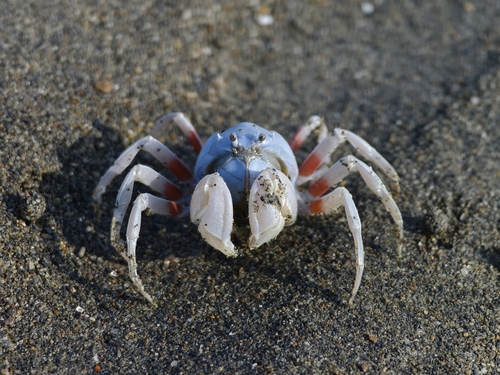
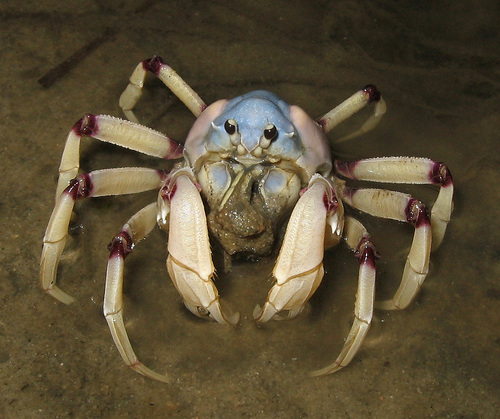
Mictyris longicarpus has a nearly spherical, upright body. Its carapace is powder blue, the rest of the body is white with purple patches on the leg joints. Its slim chelae (claws) curve downward and are held vertically in front of the crab. Due to the crab’s upright posture, its eyestalks are short. The body can measure up to 25 mm (0.98 in) across, about the size of a cherry. This species occurs in a range extending from Singapore and the Bay of Bengal to New Caledonia and Australia. On the Australian coast, it reaches as far south as Perth, Western Australia in the west, and along the coasts of Queensland and New South Wales extends south to Wilsons Promontory, Victoria. Analysis of gut contents shows M. longicarpus feeds mostly on detritus, along with small organisms found in sand including diatoms, gastropod eggs, and nematodes. Known predators of adult Mictyris longicarpus include straw-necked ibis (Threskiornis spinicollis), Torresian kingfisher (Todiramphus sordidus), great egret (Egretta alba), common toadfish (Tetractenos hamiltoni), and the grapsid crab Metopograpsus messor. This species, a type of soldier crab, is also attacked by the ghost crab Ocypode ceratophthalma and the moon snail Conuber sordidum.