About Mictis profana (Fabricius, 1803)
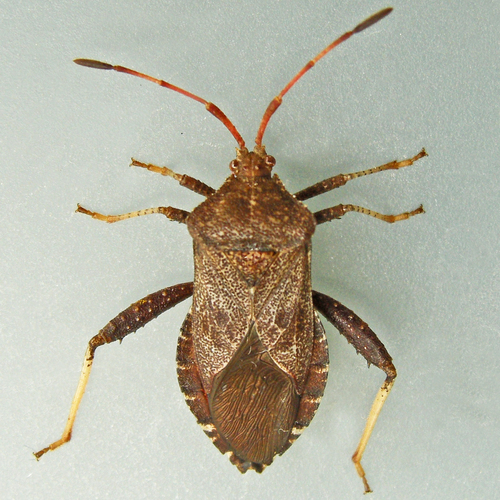
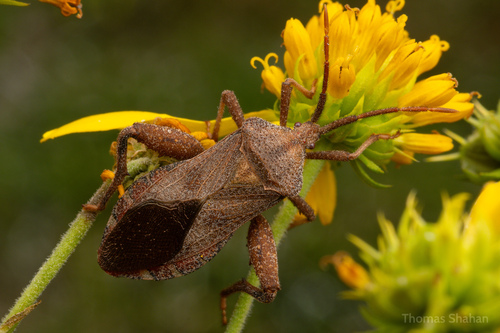
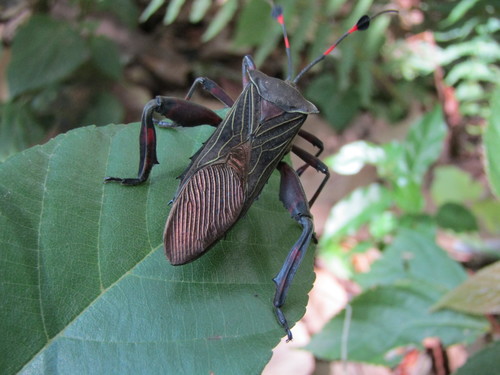
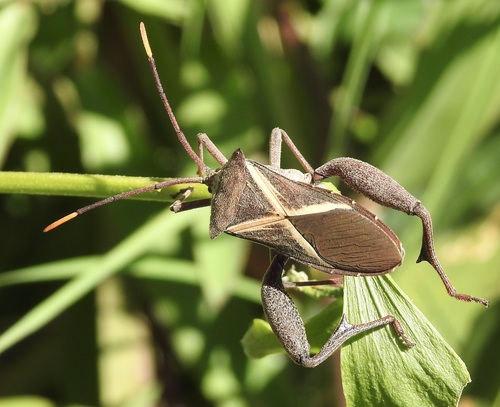
This species, Mictis profana (Fabricius, 1803), has the following characteristics. Adult Mictis profana measure 20–25 mm in length and 7–10 mm in width. They have a stout body shape, and their base color ranges from grey to brown, with a distinct cream or yellow saltire marking on the back. Adults have long legs, and the shoulder regions of their pronotum extend into short spines, a feature also present in older nymphs. The hind legs are far thicker than the front and middle legs. The hind femur has inner rows of fine teeth and one preapical spine. In males, the hind legs are shorter and noticeably more swollen than in females. The hind tibia has an inward, flattened lamellate structure across roughly its middle third; this structure is less developed in males, and males also have a distinct spine located on the lamellate area. For later instar nymphs, there is a pair of orange spots on the center of the upper abdominal surface, and the wing pads of these nymphs are marked with orange. Mictis profana is polyphagous, and has been documented feeding on a wide range of both native and introduced plants. These include eucalypts, wattles, orchard trees like citrus, and cultivated crops such as grape, pawpaw, cowpea, tomato, beans, and green gram. While it is classified as a minor pest of citrus and wattles, it is also recognized as a useful biological control agent for the invasive weed Mimosa pigra.