About Micrurus surinamensis (Cuvier, 1816)
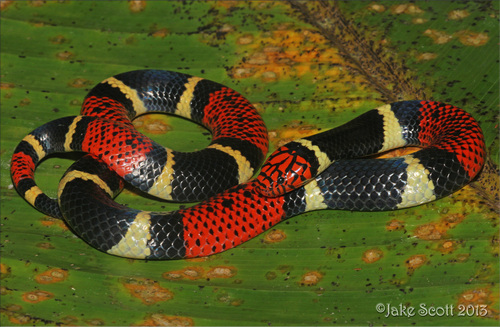
Micrurus surinamensis is one of the heaviest and most robust coral snake species. On average, individuals grow 80–100 cm long, with a confirmed maximum length of 135 cm; there are also unproven reports of specimens reaching 180 cm. This species can be distinguished by a long snout, large head, and eyes and nostrils positioned more dorsally than those of other coral snakes. Its head is mostly red, marked with distinct sharp black scales. Dorsal scales are thin and shiny; males have supra-anal keels, though these structures are only weakly developed. Body patterning consists of red rings separated by 5 to 8 triads; each triad has a wide middle red ring flanked by two narrow black rings, with narrow cream or yellowish rings separating these black triad components. Micrurus surinamensis has primarily aquatic habits, swims very effectively, and can stay submerged for long periods. It is mainly nocturnal, but may also be active during the day. When disturbed, it is not aggressive toward humans; it responds by flattening its body and raising its tail. This species is oviparous, but clutch size has not yet been documented. Its diet consists mainly of swamp eels, bony fish, other snakes, and amphibians. This species is endemic to South America, where it occurs in Bolivia, Brazil, Colombia, Ecuador, Guyana, French Guiana, Peru, Suriname, and Venezuela. Its range centers on the Orinoco River drainage and the Amazon rainforest. It inhabits humid low-mountain forests, and tropical forests along streams, rivers, and other bodies of water. It is also common in humid lowland forest areas near sea level, up to an elevation of 600 meters.