About Micrurus fulvius (Linnaeus, 1766)
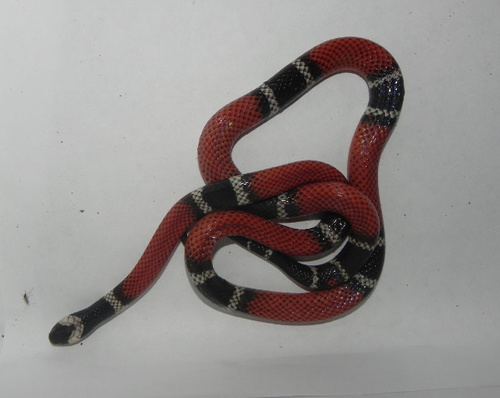
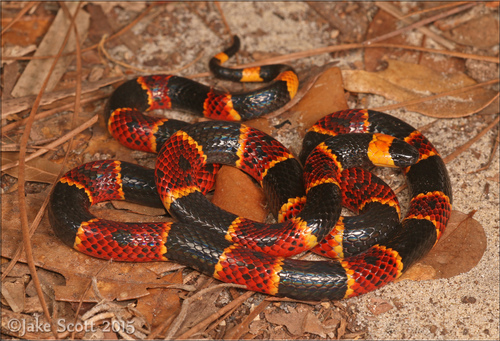
Micrurus fulvius, commonly known as the eastern coral snake, is usually less than 80 cm (31 in) in total length, including the tail. The maximum reported total lengths are 121.8 cm (48.0 in) for a specimen collected in Florida (Neill, 1958), and 129.5 cm (51.0 in) (Roze, 1996). Males have longer tails than females, but females grow to a greater total length than males. Its dorsal scales are smooth, and arranged in 15 rows at midbody. Males have 197–217 ventral scales, while females have 219–233. Males have 40–47 subcaudals, and females have 30–37. The anal plate is divided. Historically, Micrurus fulvius ranged across the Southeastern United States from the southern tip of Florida to the Sandhills of North Carolina. Currently, it is found in the Southeastern United States from southeastern North Carolina, south through South Carolina and peninsular Florida, and west through southern Georgia, Alabama and Mississippi to southeastern Louisiana. Coral snakes found in Texas, western Louisiana, and southeastern Arkansas are now classified as a separate species, Micrurus tener, which was previously considered a subspecies of M. fulvius. M. fulvius can be found at altitudes from near sea level to about 400 m (1,300 ft). Climate change is predicted to cause the current range of the eastern coral snake to expand. Both M. fulvius and M. tener are expected to have shifting ranges as the climate warms, and future models predict both species could expand their ranges up to 200 km (120 mi) northward. In Florida, Micrurus fulvius occurs in upland mesophytic and tropical hammocks, as well as glade land, high pine, scrub oak and live oak hammock, slash pine and wiregrass flatwoods. In southern Georgia and Florida, it occurs in dry open areas that are bushy but not heavily vegetated. It is associated with sandy ridges in Mississippi and sandy creek bottoms in Louisiana. At a fine geographic scale, M. fulvius prefers sandy soils within scrubby habitats. It is rarer in North and South Carolina, where it is most often found in scrub oak forests and pitch pine habitats near the coast, as well as the Southeast's coastal plain. It prefers coastal plains, and as a secretive species, it requires vegetative debris to hide in. Sexually mature Micrurus fulvius breed from late summer and early autumn through to late spring and early summer. After breeding, females lay eggs in mid-summer. Reported clutch sizes for M. fulvius range from three to 12 eggs laid in June, which hatch in September. Hatchlings measure 18–23 cm (7.1–9.1 in) in total length, including the tail. Males reach sexual maturity 11–16 months after hatching, while females reach sexual maturity approximately 26 months after hatching. Adult females are typically larger than adult males. No form of parental care for hatchlings has ever been recorded for this species.