About Microtus pennsylvanicus (Ord, 1815)
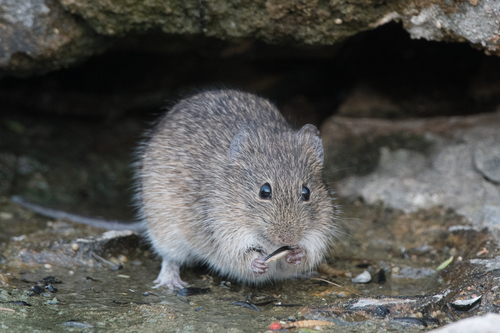
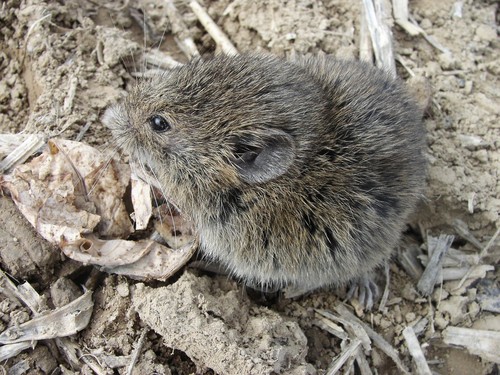
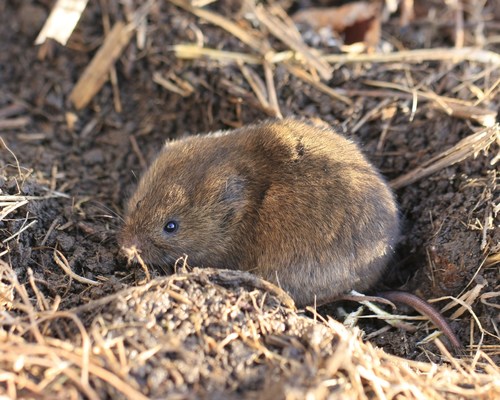
The eastern meadow vole, scientifically named Microtus pennsylvanicus (Ord, 1815), is sometimes referred to as the field mouse or meadow mouse. It is a North American vole species found in eastern Canada and the United States, with its range extending further south along the Atlantic coast. The western meadow vole, Florida salt marsh vole, and beach vole were previously classified as regional variants or subspecies of M. pennsylvanicus, but all are now recognized as separate species. Eastern meadow voles are active year-round, most often at night. They dig burrows that they use to store food for winter, and where females give birth to their young. While these animals typically live close to one another, they are aggressive toward conspecifics, a trait that is especially noticeable in males during the breeding season. Eastern meadow voles can cause damage to fruit trees, garden plants, and commercial grain crops. The eastern meadow vole occurs throughout eastern North America, ranging from Labrador and New Brunswick south to South Carolina and the extreme northeastern part of Georgia, and west through Tennessee to Ohio. West of Ohio, it is replaced by the western meadow vole. Several subspecies, including the beach vole (M. p. breweri) and the extinct Gull Island vole, live on eastern islands. Optimal habitat for the eastern meadow vole is moist, dense grassland with large amounts of plant litter. Habitat selection is mainly shaped by the relative ground cover of grasses and forbs, soil temperature, moisture, sodium, potassium, and pH levels, humidity, and interspecific competition. Eastern meadow voles are most commonly found at sites with high soil moisture. When they share habitat with prairie voles (Microtus ochrogaster) or montane voles, they are often restricted to wetter microsites. In eastern Massachusetts, eastern meadow vole density in a mosaic of grassy fields and mixed woods was positively correlated with lower vertical woody stem density and lower shrub cover. Density was highest on plots with more forbs and grasses and less woody cover; when grassy cover was not available, eastern meadow voles preferred woody cover over sparse vegetation. In West Virginia, eastern meadow voles were only captured in seedling stand forested habitats. In Pennsylvania, three subadult eastern meadow voles were captured at least 1.6 miles (2.6 km) from the nearest notable suitable habitat for the species, suggesting they are adapted for long-distance dispersal. In Ohio, researchers investigated the effects of patch shape and proportion of edge by mowing strips between study plots. The square plots were 132 feet per side (40 m x 40 m), while rectangular patches measured 52.8 feet by 330 feet (16 m x 100 m). Eastern meadow vole density did not differ significantly between square and rectangular habitat patches, and edge effects were not detected for patches of this size, indicating the species is edge-tolerant. Habitat patch shape did impact dispersal and space use behaviors: in rectangular patches, home ranges had a similar size to those in square patches but were elongated. Eastern meadow voles generally stay within their home ranges and defend at least part of their home ranges from other members of the species. Home ranges overlap and have irregular shapes. Home range size depends on season, habitat, and population density: ranges are larger in summer than in winter, ranges in marshes are larger than those in meadows, and ranges are smaller when population density is higher. Home ranges vary in size from 0.08 to 2.3 hectares (0.32–0.9 acres). Females have smaller home ranges than males, but are more territorial than males; often, juveniles from one litter are still in the adult female's home range when the next litter is born. Female territoriality tends to determine density in suboptimal habitats; the amount of available forage may determine female territory size, and thus reproductive success. Gestation for the eastern meadow vole lasts 20 to 23 days. Newborn voles are pink and hairless, with closed eyes and closed ears. Fur starts to grow by three days of age, and young are fully furred except for the belly by seven days. Eyes and ears open by eight days, and weaning takes place between 12 and 14 days. Young born in spring and early summer reach adult weight in 12 weeks, but lose weight in the fall. Young born in late summer continue growing through the fall and keep their weight through the winter. Maximum size is reached between two and 10 months of age. Typical litters of eastern meadow voles contain four to six young, with a minimum of one and a maximum of 11 young per litter. On average, 2.6 young are successfully weaned per litter. Litter size is not significantly correlated with latitude, elevation, or population density. Litters born in fall, winter, and spring tend to be smaller than summer litters. Litter size is positively correlated with female body size, and does not differ significantly between first-time breeding females and females that have bred before. First-time breeding females have fewer young per litter than females that have bred before. Litter size stays consistent during summer breeding periods across different population densities. Female eastern meadow voles reach reproductive maturity earlier than males; some ovulate and become pregnant as early as three weeks old. Males usually do not produce mature sperm until they are six to eight weeks old. One captive female produced 17 litters in one year, totaling 83 young. One of her offspring produced 13 litters (totaling 78 young) before reaching one year old. Mortality patterns vary across eastern meadow vole populations. The average lifespan of an eastern meadow vole is less than one month, due to high mortality among nestlings and juveniles. The average period that adults can be recaptured in a given habitat is about two months, which suggests the average remaining lifespan for adult eastern meadow voles is about two months, not accounting for emigration. Mortality is 88% in the first 30 days after birth. Post-nestling juveniles have the highest mortality rate at 61%, followed by young adults at 58%, older age groups at 53%, and nestlings have the lowest estimated mortality rate at 50%. Estimated mean longevity ranges from two to 16 months. The maximum lifespan in the wild is 16 months, and very few voles live more than two years. Eastern meadow vole populations fluctuate every year, and generally reach peak densities at intervals of two to five years, with population declines in the years between peaks. Breeding often stops in January and restarts in March. Over the course of a year, eastern meadow vole populations are typically lowest in early spring, and increase rapidly through summer and fall. In years with average population sizes, typical population density in old-field habitat is around 15 to 45 voles per acre. In peak years, densities can reach 150 voles per acre in marsh habitat, which is more favorable for the species than old fields. Peak abundance can exceed 1,482 voles per hectare (600 per acre) in northern prairie wetlands. In optimal habitats in Virginia (old fields with dense vegetation), densities reached 983 voles per hectare (398 per acre); populations declined to 67 per hectare (27 per acre) at the lowest point of their population cycle. Different authors have identified different primary factors influencing population density. Reich listed the following factors that have been proposed by other authors: food quality, predation, climatic events, density-related physiological stress, and the presence of genetically determined behavioral variants among dispersing individuals. Normal population cycles do not occur when dispersal is prevented; under normal conditions, dispersers are behaviorally, genetically, and demographically different from resident voles. It is thought that a threshold density of vegetation cover is required for eastern meadow vole populations to increase. Above this threshold, the amount of cover influences how large the population peak is and possibly how long it lasts. Local patches of dense cover can act as source populations or reservoirs to colonize less favorable habitats with sparse cover. Eastern meadow voles form extensive colonies and develop shared communal latrine areas. They are socially aggressive and agonistic; females dominate males, and males fight with one another.