About Microtus californicus (Peale, 1848)
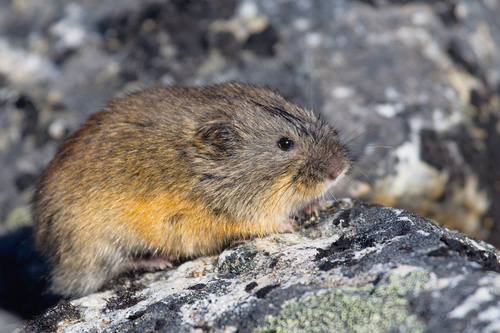
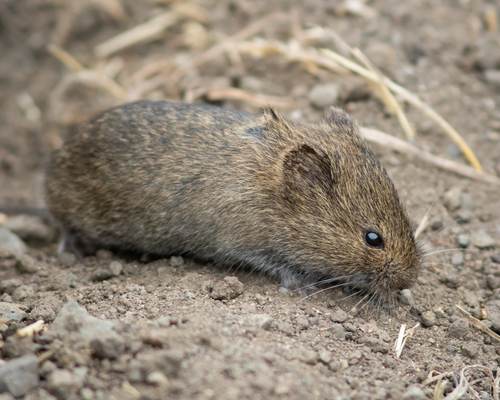
The California vole (Microtus californicus, Peale, 1848) is a medium-sized vole, and is a typical member of its group in general appearance. Male California voles have a head-body length ranging from 152 to 196 mm (6.0 to 7.7 in), with a tail between 42 and 58 mm (1.7 to 2.3 in) long. Females are significantly smaller, with a head-body length of 149 to 182 mm (5.9 to 7.2 in) and a tail measuring 38 to 53 mm (1.5 to 2.1 in). Males weigh 41 to 81 g (1.4 to 2.9 oz), while females weigh 36 to 63 g (1.3 to 2.2 oz). There is considerable size variation between different subspecies: southern subspecies tend to be larger than subspecies found further north. The California vole's body is covered in fur that ranges from cinnamon to tawny olive, ticked with occasional darker hairs, and fades to medium grey on the underside. Its tail is black on the upper side and grey on the underside. Both the whiskers and feet are grey, with a small patch of white fur near the anus. Among subspecies, those native to higher elevation habitats tend to have more reddish fur, while those living in marshier environments tend to be darker. Males have a pair of scent glands on the hips that they use to mark their trackways. Females have four pairs of teats: two located on the chest, and two closer to the groin. The California vole is distributed from El Rosario in Baja California in the south, through most of California, and as far north as Eugene, Oregon. It is not found in most of the deserts of southeastern California, nor in the extreme northeastern and northwestern corners of California. It lives in a range of different grassland habitats, from wet coastal marshland to dry uplands and savannah. The California vole is herbivorous, feeding mainly on grasses and sedges, with other flowering herbs as a supplementary food source. Its preferred foods include wild oats, ryegrass, and brome grass; all of these are introduced species from Europe, so they cannot be the species' original native diet. California voles can become agricultural pests, causing widespread damage especially to artichoke fields, and also damage crops including alfalfa, potatoes, and asparagus. Because the California vole is relatively common and widespread, it has many natural predators, including hawks, owls, egrets, long-tailed weasels, coyotes, skunks, mountain lions and garter snakes. California voles can breed almost year-round, though most breeding takes place in the middle of the wet season, from March to April. Males may breed with more than one female, but the species is not as strongly polygynous as some other voles. Copulation can be prolonged and repeated, and is followed by formation of a copulatory plug and induced ovulation. Gestation lasts three weeks and results in the birth of up to 10 young, with four or five being the most common litter size. Females are ready to breed again within 15 hours of giving birth, and may produce several litters over the course of their life. Newborn young are born hairless and blind, with an average weight of 2.8 g (0.099 oz). They begin growing fur within five days of birth, and their eyes open at 9 days old, though they can sense light before this point. Young are weaned at around two weeks of age, and have a full set of adult teeth by three weeks. Females reach sexual maturity in as little as three weeks, while males reach sexual maturity after six weeks. The lifespan of California voles is correspondingly short: most individuals live for less than a year, even when no predators are present.