About Microtis parviflora R.Br.
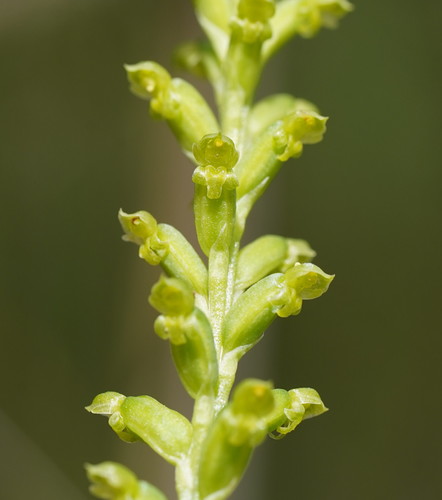
Microtis parviflora R.Br. is a terrestrial, perennial, deciduous herb that grows from an underground tuber. It produces a single erect, smooth, tubular leaf that is 20–50 cm (8–20 in) long. The leaf ends in a pointed tip and is usually longer than the plant's flower spike. Between ten and eighty small green flowers are densely arranged on an erect, fleshy raceme that grows 20–50 cm (8–20 in) tall. Each flower has a pedicel around 1 mm (0.04 in) long that holds the flower away from the main spike. The ovary is roughly oval in shape, measuring 3–5 mm (0.1–0.2 in) long. The dorsal sepal ranges from egg-shaped to round, is about 2 mm (0.08 in) long, and forms a hood over the column alongside the petals. The lateral sepals are linear in shape, are slightly shorter than the dorsal sepal, and roll backward as they mature. The labellum is 1 to 2 mm (0.04 to 0.08 in) long, roughly heart-shaped, and curves downward in a semicircle. Two relatively large, egg-shaped calli are located at the base of the labellum. Flowering occurs from October to February, and extends to March in New Zealand. This species, commonly called the slender onion-orchid, occurs in all Australian states except the Northern Territory. There is some uncertainty about whether it grows in Western Australia, though multiple authors have recorded its presence in semi-arid areas of the state. In Australia, Microtis parviflora is common, widespread across many habitats, and grows most often in moist soils. In New Zealand, it is found on both the North and South Islands, where it typically grows in locations with sparse overhead vegetation.