About Microsorum punctatum (L.) Copel.
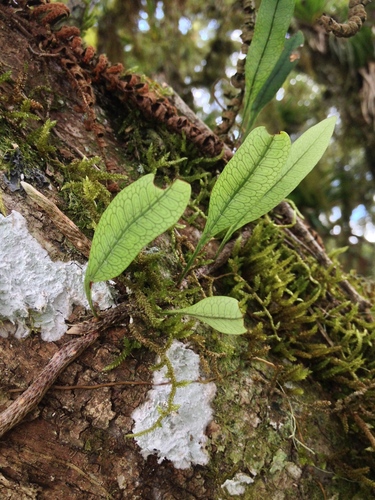
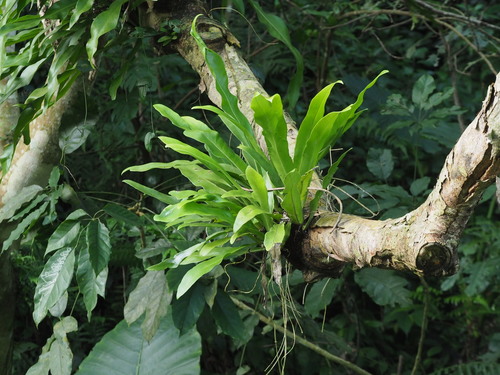
Microsorum punctatum (L.) Copel. belongs to the subfamily Microsoroideae. Like other members of this subfamily, it is a facultative epiphyte: it often grows epiphytically, but can also grow terrestrially on the soil surface in moist, well-drained areas.
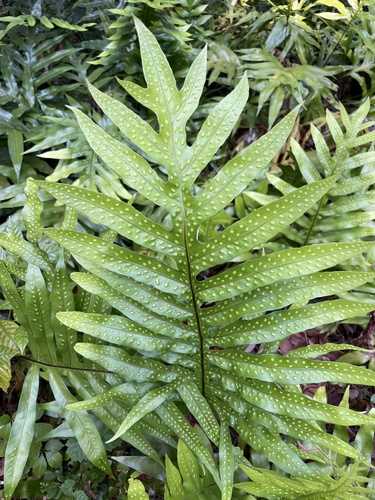
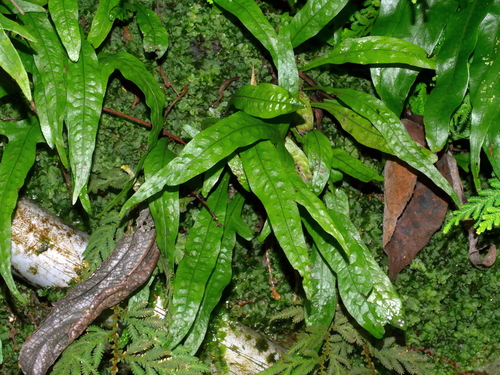
Its rhizome is small and short, reaching up to 50 mm in diameter. It is covered in dark brown, elongated triangle-like scales that are 8 mm long. Its single leaves are lanceolate in shape, green, 550 mm long, and 50 mm wide. Leaves have an indistinct petiole, a clearly visible 3 mm diameter midrib, a pointed tip, a winged leaf base, and branched venation.
This species is distributed across Africa and Asia. It is native to the Andaman Islands, Angola, Assam, Bangladesh, Bismarck Archipelago, Borneo, Burundi, Cambodia, Cameroon, Cape Provinces, Caroline Islands, Central African Republic, north-central China, south-central China, southeast China, Christmas Island, Comoros, Eastern Himalayas, Equatorial Guinea, Ethiopia, Fiji, Gabon, Ghana, Guinea, Gulf of Guinea islands, Hainan, India, Ivory Coast, Jawa, Kenya, KwaZulu-Natal, Laos, Lesser Sunda Islands, Liberia, Madagascar, Malaya, Maluku, Marianas, Marquesas, Mauritius, Mozambique, Myanmar, Nepal, New Caledonia, New Guinea, New South Wales, Nicobar Islands, Nigeria, Northern Provinces, Philippines, Queensland, Rwanda, Réunion, Seychelles, Sierra Leone, Society Islands, Solomon Islands, Sri Lanka, Sulawesi, Sumatera, Taiwan, Tanzania, Thailand, Uganda, Vanuatu, Vietnam, Zambia, Zaïre, and Zimbabwe. It has been introduced to Colombia.
In the traditional medicine of Assam, juice extracted from the fronds of this fern is used as a purgative, diuretic, and wound healing agent.