About Microrhopias quixensis (Cornalia, 1849)
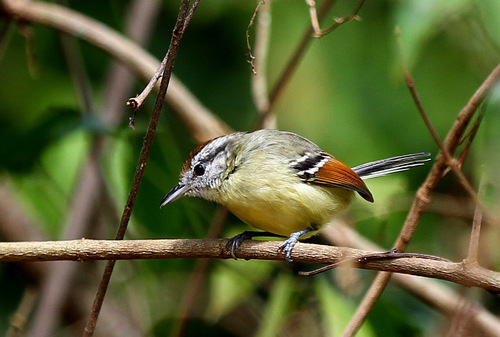
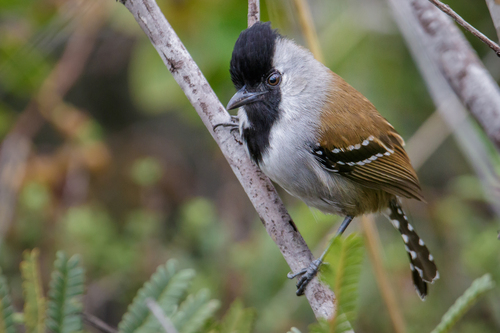
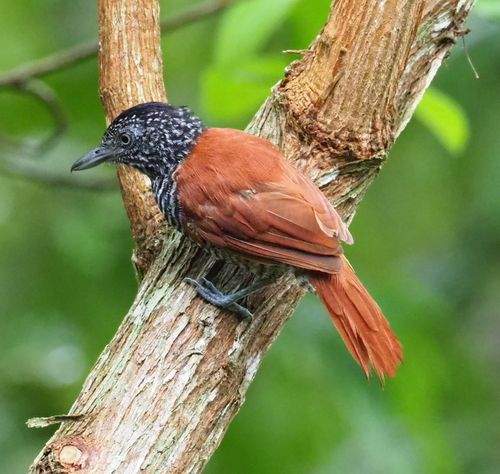
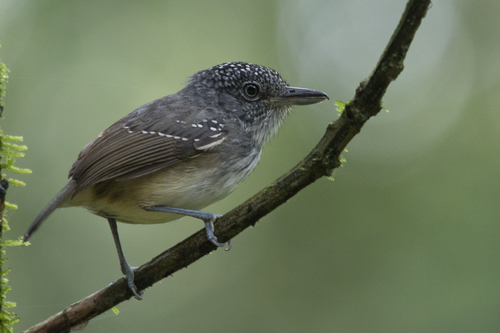
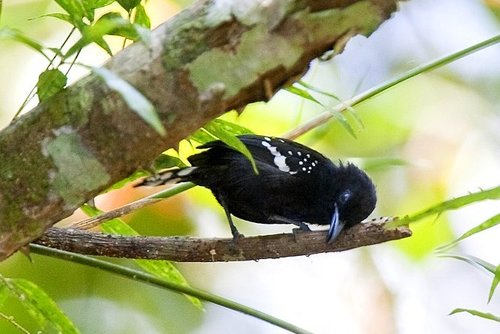
The dot-winged antwren (scientific name Microrhopias quixensis, first described by Cornalia in 1849) measures 10 to 12.5 cm (3.9 to 4.9 in) long and weighs 7.5 to 11.5 g (0.26 to 0.41 oz). This species has a long graduated tail, and males and females have different plumage. Adults of the nominate subspecies M. q. quixensis are mostly black, with a partly concealed white patch between the shoulders. Their greater wing coverts have large white tips, and their other coverts have smaller white tips. Additional white areas appear on the underside of their wings. Their flight feathers are dark gray with a brown tinge. Their central tail feathers are black, and the remaining tail feathers have progressively larger white tips moving from the innermost to the outermost feather. Adult females have blackish gray heads and upperparts, a black throat, and rufous-chestnut underparts that are darkest on the breast. The pattern of white markings on their wings and tail matches that of males. The other recognized subspecies of dot-winged antwren differ from the nominate subspecies and from one another as follows. M. q. boucardi has smaller white tail tips than the nominate; females have cinnamon underparts with a rufous tinge. M. q. virgatus has smaller white tail tips than the nominate; females have cinnamon-rufous underparts. M. q. consobrina is smaller than the nominate and has larger white tail tips; females have rufous-chestnut to rufous underparts. M. q. intercedens has larger white tips on tail feathers than the nominate; females have blackish gray upperparts, and rufous throat and underparts. M. q. nigriventris has more white on wing coverts and outer tail feathers than the nominate; females have deep chestnut breasts, and black bellies and undertail coverts. M. q. albicauda has smaller white spots on wing coverts than the nominate, with more white on tail feathers, and the outermost tail feather is almost entirely white; females have dark gray crowns and upper backs, mostly cinnamon-rufous underparts, and dark gray flanks. M. q. microstictus has smaller white spots on wing coverts than the nominate; females have rufous throat and underparts, and rufous flanks with dark gray markings. M. q. bicolor has larger white tips on tail feathers than the nominate; females have dark gray upperparts, and rufous throat and underparts. M. q. emiliae has smaller white tail tips than the nominate; females have chestnut-rufous lower throats and upper breasts, and black upper throats, lower breasts, and bellies. Subspecies M. q. boucardi and M. q. virgatus intergrade in Honduras, and they may be a single subspecies. Each subspecies of dot-winged antwren has a distinct range. M. q. boucardi occurs from Veracruz and Oaxaca in Mexico, east and south through Belize and eastern Guatemala into northern Honduras. M. q. virgatus ranges from southeastern Honduras south through eastern Nicaragua and eastern Costa Rica into Panama, reaching as far as Panamá Province and Guna Yala, formerly known as San Blas; it is also found on the Pacific slope of central and southern Costa Rica, and locally on Panama's Pacific slope. M. q. consobrina ranges from Panama's Guna Yala and Darién Province through north-central and western Colombia into Ecuador, as far south as Guayas Province. M. q. quixensis occurs from southern Colombia's Putumayo and Caquetá departments south through eastern Ecuador into northeastern Peru, reaching the Marañón and Amazon rivers. M. q. intercedens is found in central Peru and southwestern Brazil south of the Amazon, extending east as far as the Madeira River. M. q. nigriventris lives on the eastern Andes and its foothills in central Peru, between the San Martín and Cuzco departments. M. q. albicauda ranges from Peru's Ucayali Department southeast into northern Bolivia's Pando Department. M. q. microstictus occurs in the Guianas and the northeastern Amazonian Brazilian states of Roraima, extreme northern Pará, and Amapá. M. q. bicolor is found in Amazonian Brazil south of the Amazon, between the Madeira and Tapajós rivers, and south to Rondônia and northwestern Mato Grosso. M. q. emiliae occurs in Amazonian Brazil south of the Amazon, between the Tapajós and Tocantins rivers, and south to extreme northern Mato Grosso. Across its extremely large range, the dot-winged antwren inhabits somewhat different landscapes. In general, it lives in tropical evergreen forest and secondary forest heavily vegetated with vine tangles, and favors forest edges and gaps, mostly avoiding the interior of continuous forest. In northern Central America, its habitat includes low semi-deciduous forest and some rainforest. In southern Central America, it also occurs in shaded cacao and guava plantations. In Ecuador and western Amazonia, the species often favors stands of bamboo and várzea forest. In Mato Grosso, subspecies M. q. bicolor most often occurs in gaps within terra firme forest. Subspecies M. q. emiliae is mostly associated with stands of Guadua bamboo.