About Micropterus treculii (Vaillant & Bocourt, 1874)
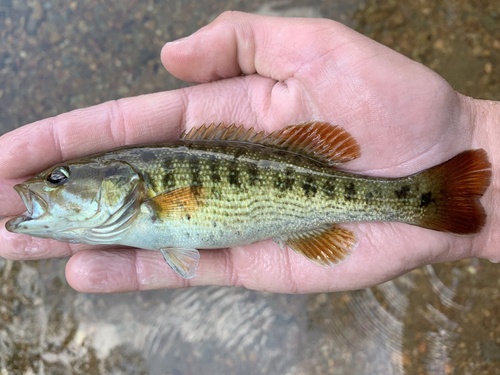
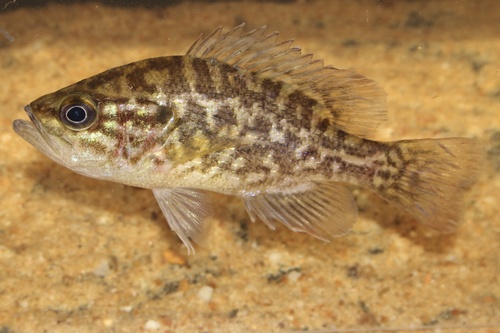
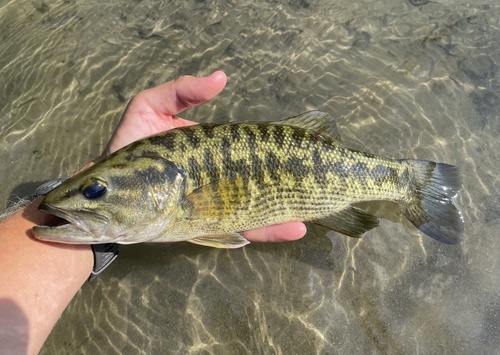
This species is commonly known as the Guadalupe bass, with the scientific name Micropterus treculii (Vaillant & Bocourt, 1874). Like most black bass, Guadalupe bass have a base body color ranging from lime to olive green. River-dwelling specimens of this species are typically lighter in overall shade. A series of mostly separate diamond-shaped or circular spots runs along the Guadalupe bass’s lateral line; these spots fade from black to olive as the fish ages. Many smaller, less distinct diamond-shaped marks are also scattered across the fish’s back, less prominent than the spots along the lateral line. Guadalupe bass have a rectangular tooth patch on their tongue. Their physical characteristics are very similar to spotted bass—both have a small mouth that does not extend past the eye and a sleek body shape, for example—but Guadalupe bass differ in one key trait: their green body color extends lower on the body, past the lateral line, than it does in their close relatives. As of current records, the largest Guadalupe bass ever caught weighed 3.71 pounds (equal to 3 pounds 11.4 ounces). This record catch was made by Dr. Bryan Townsend of Austin in 2014.
Guadalupe bass are only found in the Edwards Plateau region of central Texas. Their primary native habitats are the San Marcos, Colorado, Llano, and Guadalupe Rivers, but they also occur in smaller local streams including Barton Creek, Onion Creek, the San Gabriel River, and the Comal River. This species has also been farm-raised and stocked in the Llano River.
Typically, Guadalupe bass live in streams and reservoirs, and are not present in extreme headwaters. They prefer flowing stream waters within their native range, and use cover such as large rocks, cypress trees, or stumps to take refuge. Juvenile Guadalupe bass are most often found in fast-moving water, but by the end of their first year they move into deeper areas with moderate current.
Both male and female Guadalupe bass reach adulthood and sexual maturity at one year of age. Their spawning season can start as early as March and continues into June, varying based on location and water conditions. Unlike many other bass species, Guadalupe bass may have a secondary spawning event in late summer or early fall. Males select and build a gravel spawning nest in shallow water: the site has a high overall flow rate, but sits out of the direct path of the fastest moving water. A well-constructed gravel nest is important because it attracts females to spawn. After a female lays between 400 and 9000 eggs, the male immediately chases her away from the nest. From that point, the male guards the nest from predators and stops eating, though he may strike a lure to defend his territory. The male continues to guard the newly hatched fry after they emerge from the eggs. Once hatched, the fry feed on invertebrates.