About Micropterus dolomieu Lacepède, 1802
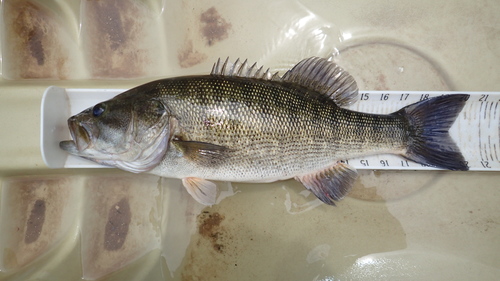
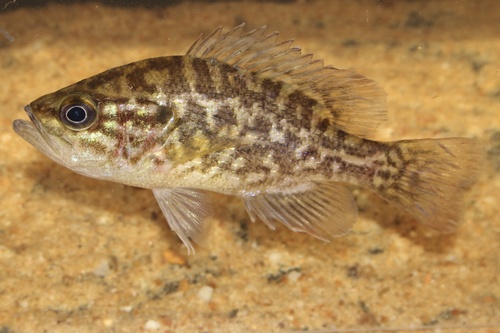
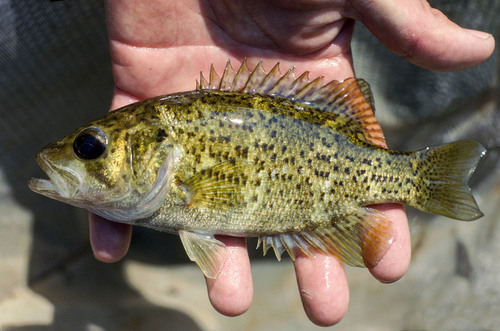
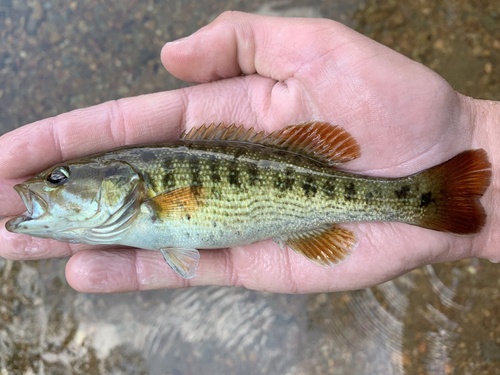
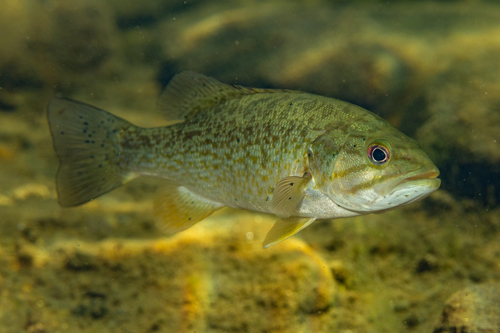
Micropterus dolomieu (commonly called smallmouth bass) have a slender, muscular fusiform body shape that makes them powerful swimmers. Their ctenoid scales are colored golden-olive to dark brown on the dorsal side, fading to yellowish white on the ventral side; they also have dark brown vertical bars or blotches along the body, and dark brown horizontal bars on the head. This combination of muscular fusiform body shape and camouflage-like coloring makes smallmouth bass highly effective ambush predators. Their coloration can vary greatly depending on the fish's age, habitat, water quality, diet, and spawning cycle. Generally, the protruding jaw of the smallmouth does not extend back past the eyes, which are red or brown. They have two dorsal fins separated by a shallow interdorsal notch; the front dorsal fin has 9–11 spiny rays, and the back dorsal fin has 13–15 soft rays. Males are generally smaller than females. Males usually weigh around two pounds, while females can range from three to six pounds. Average size and coloration differ between populations found in lacustrine (lake) versus riverine habitats. Smallmouth bass from riverine habitats are generally longer and more slender, which gives them greater agility in moving water, while those from lacustrine habitats are shorter with deeper bodies. Riverine smallmouth living in dark water tend to be torpedo-shaped and very dark brown, an adaptation that supports more efficient feeding. By contrast, lacustrine smallmouth bass living in sandy areas tend to be light yellow-brown and more oval-shaped. Two subspecies are currently recognized: the Northern smallmouth bass (M. dolomieu dolomieu) and the Neosho smallmouth bass (M. dolomieu velox). The Northern smallmouth bass is much more widespread than the smaller Neosho smallmouth bass subspecies. Neosho smallmouth bass are native to the ecologically isolated Central Interior Highlands region of the lower Midwest, which spans southwestern Missouri, northern Arkansas, and northeastern Oklahoma. Smallmouth bass eat tadpoles, fish, aquatic insects, and crayfish. The current world record for the largest caught smallmouth bass is 11 pounds 15 ounces (5.41 kg), caught in Dale Hollow Reservoir on the Kentucky–Tennessee border. Compared to largemouth bass, smallmouth bass live in clearer water, most commonly in streams, rivers, and the rocky areas, stumps, and sandy bottoms of lakes and reservoirs. They can also survive in stronger currents than other black bass. Smallmouth bass prefer cooler water temperatures than their close relative the largemouth bass, so they often seek out deeper, faster moving water during the hot summer months. Because smallmouth bass are intolerant of pollution, they act as a good natural indicator of a healthy environment, though they are still much more resilient than most trout species. Smallmouth bass are carnivorous; their full diet includes crayfish, amphibians, insects, and smaller fish, while larvae feed on various zooplankton and insect larvae. Adult smallmouth bass also cannibalize the young from other parents' nests. A female smallmouth bass can lay up to 21,100 eggs, which are guarded by the male in his nest.