About Micropternus brachyurus (Vieillot, 1818)
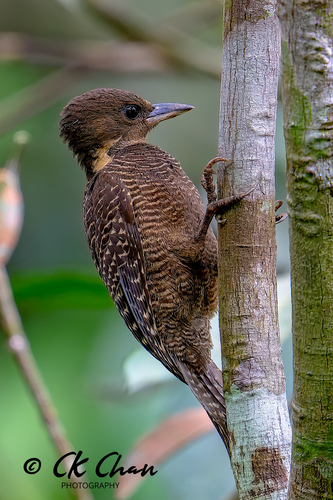
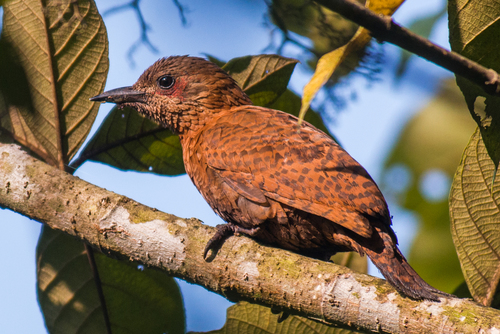
The rufous woodpecker (scientific name Micropternus brachyurus (Vieillot, 1818)) is approximately 25 centimeters long. It is overall dark brown, with dark bands on the feathers of its wings and tail that create a black-barred appearance. Its head is paler than its darker-shaded underparts. The bill is short, black, slightly curved along the culmen, and narrow at the nostrils. The tail is short and rufous with narrow black bars, but in the subspecies badiosus, the tail is dark with narrow rufous bars. Feather margins are pale in the subspecies squamigularis and annamensis. Feathers on the neck, ears, and lore are unmarked. Males have red-tipped feathers under the eyes, between the eye and ear coverts, and on the malar region, and these red-tipped feathers sometimes form a patch. Females and young woodpeckers do not have red-tipped feathers. The species has a weak but erectile crest. Juveniles typically have streaked throats, and some subspecies also have streaked throat feathers on adults. In the field, individual birds often look soiled and smell of ant secretions from Crematogaster ants, which is a result of their foraging or nesting activities; Crematogaster ants have a unique spatulate tip to their sting, which they use only to spray fluid forward at intruders from a raised gaster. In terms of behaviour and ecology, rufous woodpeckers forage in pairs at ant nests located on trees, fallen logs, and dung heaps, as well as on ant and termite hills. They have been recorded feeding on ants from the genera Crematogaster and Oecophylla. Besides insects, they have been observed feeding on nectar from flowers of Bombax and Erythrina, and consuming sap from the bases of banana fronds. The species' most common call is a sharp nasal three-note keenk-keenk-keenk, but they also produce other calls including a long wicka and a series of wick-wick notes. They have a distinctive drumming pattern that starts rapidly and then slows in tempo. Drumming takes place year-round, but increases in frequency during winter in southern India, and peaks around March to April in Nepal. A display of unknown function between two facing individuals involves swaying the head with the bill held high and the tail splayed. The breeding season falls in the pre-Monsoon dry period, from February to June. The rufous woodpecker is best known for building its nest inside the nest of acrobat ants (Crematogaster). Both the male and female participate in excavating the nest. Their feathers, especially when nesting, are reportedly covered in a dark, smelly sticky fluid, and dead ants are often found stuck to this fluid. The clutch consists of two white, matt, thin-shelled, translucent eggs. The incubation period lasts 12 to 14 days. Both parents feed the young at the nest, though a 19th-century observer noted that his Indian field assistants, who called the bird "lal sutar" meaning red carpenter, believed adults left the young to get ants to feed themselves. Moulting mainly occurs from September to November. The bird louse species Penenirmus auritus has been recorded on this woodpecker in Thailand. The species has a wide habitat range; in Malaysia, it has been found to persist even in areas where swamp forests have been cleared and replaced by oil palm plantations. Its habitat is mainly located in plains and lower hills, mostly below 3000 m. This species is not considered threatened on the IUCN Red List.