About Micropogonias furnieri (Desmarest, 1823)
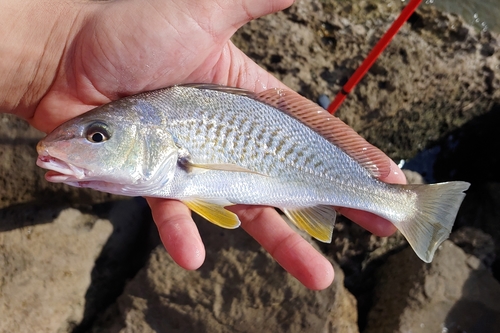
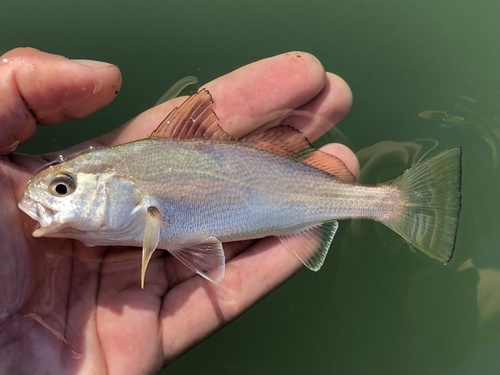
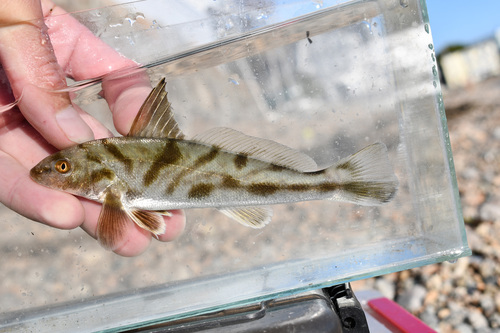
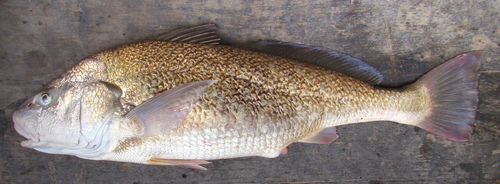
Micropogonias furnieri (originally misspelled as Micropogonia furnieri here) has a slightly compressed, elongated body, with a snout that clearly protrudes past its moderately large, inferiorly positioned mouth. The mouth holds villiform teeth arranged in bands; the outer tooth row of the upper jaw consists of teeth that are slightly larger than the rest of the teeth. The chin has 5 pores, and between 3 and 5 rather small barbels run along the side of the lower jaw, but not along the jaw edge. There are 10 pores on the snout: 5 on the front of the snout, and 5 along the snout's side. The eye is relatively large, and the preoperculum has thick, robust serrations along its edge. The dorsal fin is incised; there are 10 spines before the incision, and one spine plus between 26 and 30 soft rays after the incision, with most individuals having no more than 27 soft rays. The anal fin is supported by 2 spines: the second spine is robust, and measures half the length of the first anal fin ray, alongside between 7 and 9 soft rays. The caudal fin has a concave edge on both its upper and lower lobes, which are separated by an angular point. This species has an overall silver body, with a brown back marked by dark vertical streaks that extend to just below the lateral line. The maximum published total length for this species, commonly called the whitemouth croaker, is 60 cm (24 in), though a total length of 45 cm (18 in) is more typical. Micropogonias furnieri is distributed in the western Atlantic Ocean: its range extends from the Gulf of Mexico off Veracruz and northeastern Cuba, south through the Caribbean from Cuba southwards, and along the coasts of Central and South America from southern Belize south to northern Argentina. It occurs in coastal waters at depths down to 80 m (260 ft), over muddy and sandy substrates. First-year juveniles are found around river mouths and in estuaries, while older fish inhabit deeper coastal areas. This fish is euryhaline and can tolerate some degree of habitat disturbance.