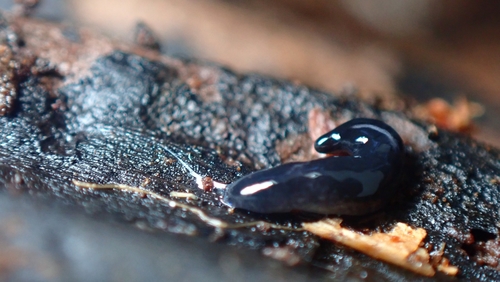
About Microplana terrestris (O.F.Müller, 1773) Linden, 1900
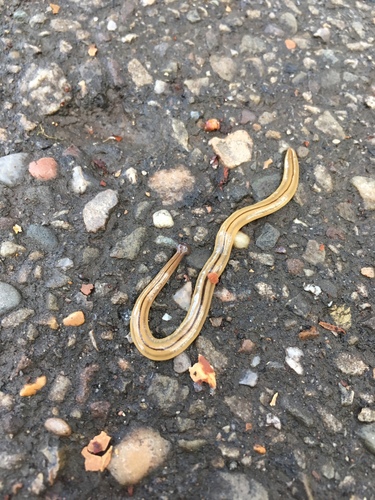
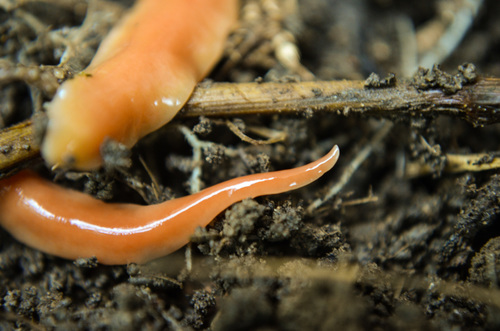
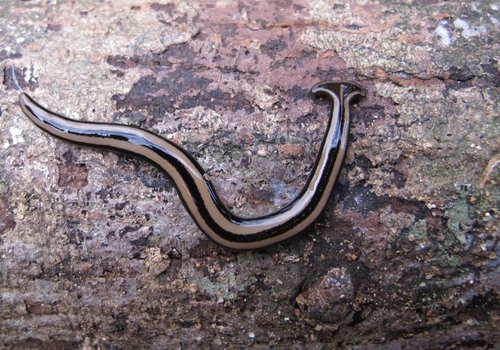
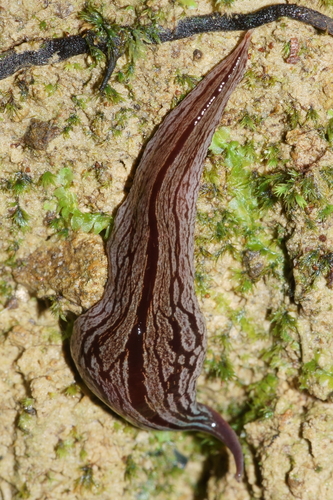
Microplana terrestris (O.F.Müller, 1773) Linden, 1900, like all flatworms, is an unsegmented, soft-bodied bilaterian that lacks a body cavity, and has no specialized circulatory or respiratory organs. Like other members of the Geoplanidae family, it is flattened across its dorso-ventral axis, and creeps with its entire ventral surface in contact with the substrate. It measures between 1 and 2 cm (0.4 and 0.8 in) long, and between 1 and 2 mm (0.04 and 0.08 in) wide. Its anterior end is blunt, and its body is usually black or dark grey in color. Microplana terrestris is native to Western Europe. Its native range extends from Sweden in the north, through the United Kingdom, Ireland, and France, to Greece in the east. It requires a moist habitat, and has also been introduced into North America. When moving, cilia provide the propulsive force for this flatworm. It can also generate stationary muscular waves along its body to speed up its movement. It produces mucus as it moves, and leaves intermittent slime "footprints" when using these stationary waves. It can use its mucus trail as a "suspension bridge" to cross between separate leaves. This flatworm is a generalist carnivore, that feeds mostly on earthworms, slugs, snails, and small arthropods. It rarely attacks live, uninjured prey, and prefers to feed on dead or injured individuals. While this species is capable of sexual reproduction, it can and frequently does reproduce asexually without mating, producing cocoons that each contain several hatchlings. The first cocoon is produced 195 (±75) days after hatching, and additional cocoons are produced approximately once per month after that. In laboratory conditions, one individual lived for 39 months. This flatworm can regenerate after being cut into two pieces, though this ability appears to greatly reduce its longevity.