About Microparra capensis (A.Smith, 1839)
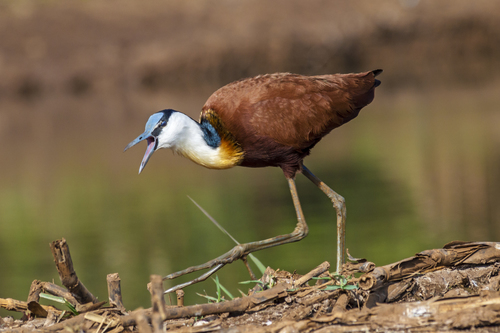
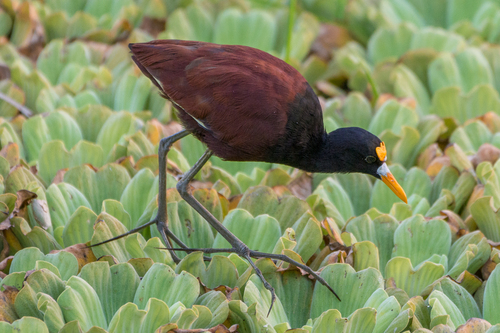
Microparra capensis, commonly called the lesser jacana, is the smallest species in the Jacanidae family. It measures 15–16 cm in length and weighs approximately 41 grams. It has a white breast, a golden forehead, a cinnamon-colored crown, and a dark eyestripe; its mantle and wings are also dark. Like other jacanas, it has long legs and claws adapted for walking on lily pads and aquatic grasses, which is why jacanas are sometimes called lily trotters or Jesus birds, as they appear to walk on the water’s surface. Lesser jacana eggs resemble the eggs of the African jacana but are smaller. Juvenile African jacanas closely resemble adult lesser jacanas, and the two may be confused where their ranges overlap in Southern Africa. In the field, lesser jacanas are reported to be more easily identified when flying, as they often hide in aquatic vegetation. When in flight, their legs appear long and trail behind the body, and their wings have a white trailing edge. The lesser jacana has minimal sexual dimorphism, with males and females being nearly identical, although females are on average 4% larger than males, and males are reported to have darker backs than females. The lesser jacana occurs in wetland habitats across Angola, Botswana, Burkina Faso, Burundi, Cameroon, Central African Republic, Chad, Democratic Republic of the Congo, Eswatini, Ivory Coast, Ethiopia, Kenya, Malawi, Mali, Mauritania, Mozambique, Namibia, Niger, Nigeria, Rwanda, Sierra Leone, South Africa, Sudan, Tanzania, Uganda, Zambia, and Zimbabwe. It occupies the shorelines of permanent and seasonally flooded wetlands across Africa, and occupies areas partially overgrown with sedge and grass. As new pools fill with rainfall, lesser jacanas may move into these newly flooded habitats. It favors areas where sedge and grass cover is sparse, but more abundant than water lilies. It uses aquatic vegetation for cover, which makes it often inconspicuous. The lesser jacana’s range overlaps with that of the African jacana, and the two species often coexist. The mating system of the lesser jacana differs from all other jacana species in the Jacanidae family. All other jacanas follow a polyandrous mating strategy with reversed sex roles: males provide all parental care, females mate with multiple males, and as a result females are slightly larger than males in these species. Observations show the lesser jacana does not use this strategy. Instead, the lesser jacana practices biparental care, where both parents cooperate to care for their young. Unlike other jacana species, where males alone incubate chicks, both male and female lesser jacanas take part in nest building and incubate eggs equally. This difference in parental care explains why the lesser jacana has minimal sexual dimorphism. The lesser jacana has been observed to be monogamous. To reproduce, the male mounts the female’s back, and copulation averages 7 seconds, which is shorter than in other jacana species due to lower levels of sperm competition. The lesser jacana lays two or three tan-colored eggs with black markings in a floating nest. Their eggs match the appearance of African jacana eggs but are smaller. Eggs are incubated for 19–21 days. During incubation, males and females hold their eggs against their breast with the underside of their wing. Once chicks hatch, parents brood their young under their wing. When chicks face apparent danger, a parent will collect its chick and carry it under its wing.