About Micromys minutus (Pallas, 1771)
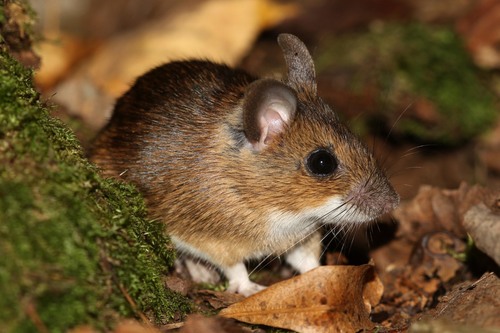
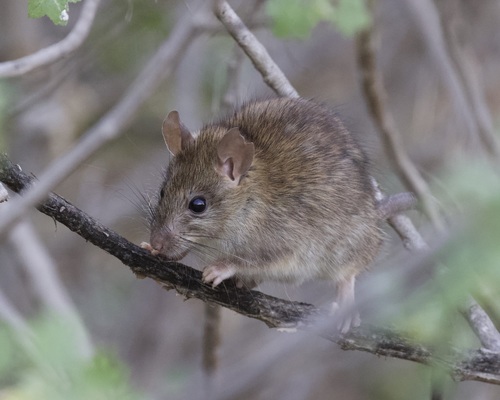
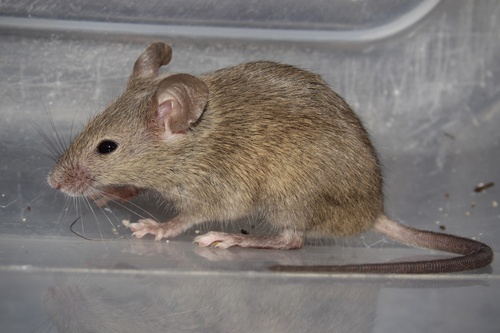
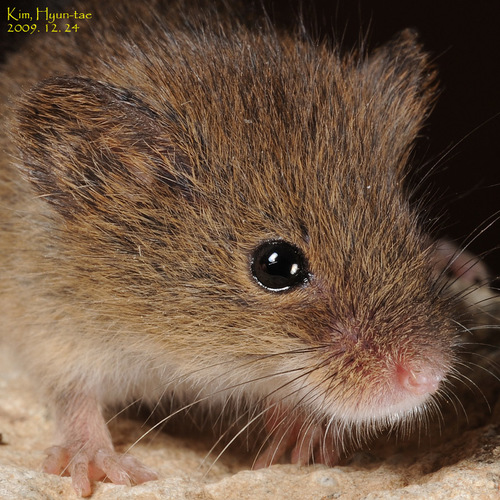
The harvest mouse (Micromys minutus) has a body length ranging from 55 to 75 mm (2.2 to 3.0 in), a tail length of 50 to 75 mm (2.0 to 3.0 in), and a body weight of 4 to 11 g (0.14 to 0.39 oz), which is around half the weight of the house mouse (Mus musculus). It has relatively large eyes and ears, a small nose with short, stubble-like whiskers, and thick, soft fur that is thicker in winter than in summer. The upper body is brown, sometimes with a yellow or red tint, while the underparts range from white to cream in color. It has a prehensile tail that is usually bicolored and hairless at the tip. Its rather broad feet are specially adapted for climbing, with a somewhat opposable large outermost toe. This adaptation lets it grip stems with each hindfoot and its tail, freeing its forepaws to collect food. The tail is also used for balance. The harvest mouse is common in all east coast counties of England, and its range reaches the North York Moors. It also lives in less favourable habitats such as woodlands and forests in the west. It occupies a wide variety of habitats, from hedgerows to railway banks. Harvest mice show a preference for all types of cereal heads, with the exception of maize (Zea mays). They typically use monocotyledons to build their nests, especially common reed (Phragmites australis) and Siberian iris (Iris sibirica). Most harvest mice prefer wetlands for their nesting habitats. In Japan, harvest mice build wintering nests near the ground from dried grasses, which shows they need vegetative cover in both winter and warmer seasons. Grasslands with a mix of perennial and annual grasses are required to support both increased nesting periods and the mice's need to obtain nutrients. Habitat selection in this species may be shaped by differences in landscape structure between local grasslands and wetlands. Like many rodent species, harvest mouse females prefer familiar males over unfamiliar ones. This adaptive preference for mating with familiar males is not uncommon, as familiarity acts as a proxy for mate quality in many solitary animals. Harvest mice are thought to be solitary, and females do prefer familiar males over unfamiliar. There is no sexual size dimorphism between males and females, so females are considered dominant over males. Females do not show interest in male odors. When females are in oestrus, they spend more time with familiar males and prefer heavier individuals. When in dioestrus, females spend more time with unfamiliar males. In most years in Britain, harvest mice build their first breeding nests in June or July, though occasional nests are built as early as April or early May. They prefer to build their breeding nests above ground. In Russia, harvest mouse breeding takes place in November and December in cereal ricks, buckwheat heads, and other cereal heads.