About Micromonacha lanceolata (Deville, 1849)
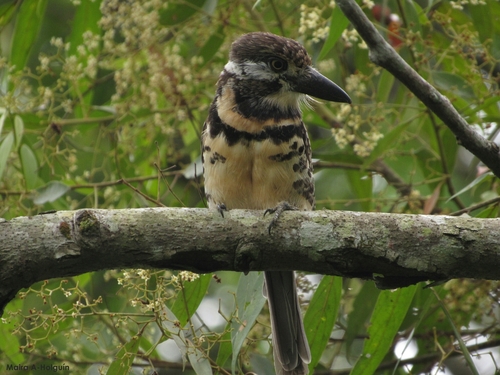
The lanceolated monklet (Micromonacha lanceolata) is 13 to 15 cm (5.1 to 5.9 in) long and weighs 19 to 22 g (0.67 to 0.78 oz). Its upper body is entirely warm brown with scale-like buffy markings. It has white bristles around the base of its large bill, plus white feather tufts that form "whiskers". Its lores and a half ring behind the eye are white. The wings and upper side of the tail are dark brown, while the underside of the tail is gray. Most of its underparts are white with heavy black streaks; the center of the belly is unstreaked, and the vent area has an ochre tinge. The lanceolated monklet is found across several separate disjunct areas. One population is located on the Caribbean slope of Costa Rica, extending into west central Panama. A second population ranges from west central Colombia south to west central Ecuador. The largest contiguous range covers eastern Ecuador, southern Colombia, western Brazil, and eastern Peru. It also occurs in a small number of locations in Bolivia. This bird inhabits a variety of landscapes, including edges and natural clearings of primary and mature secondary forest, small forest patches, shade coffee plantations, and lowland and montane evergreen forest. It typically occurs in the mid- and upper levels of vegetation. Most of its populations are found between 300 and 1,500 m (980 and 4,900 ft) in elevation, though it can be found as high as 2,100 m (6,900 ft).