About Microhyla borneensis Parker, 1928
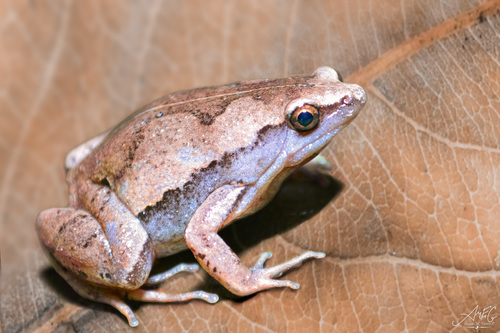
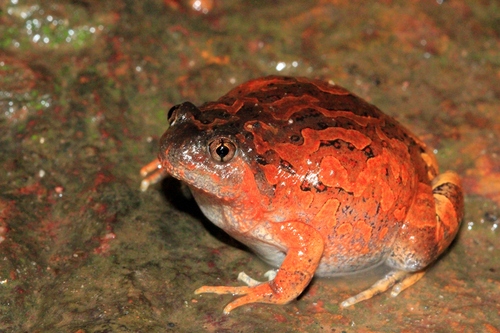
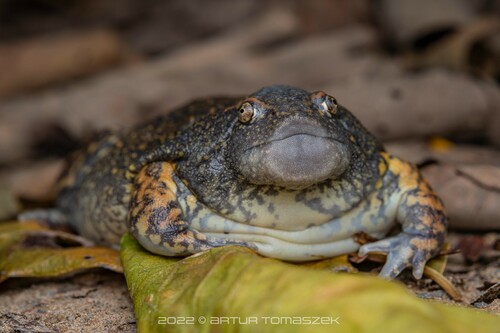
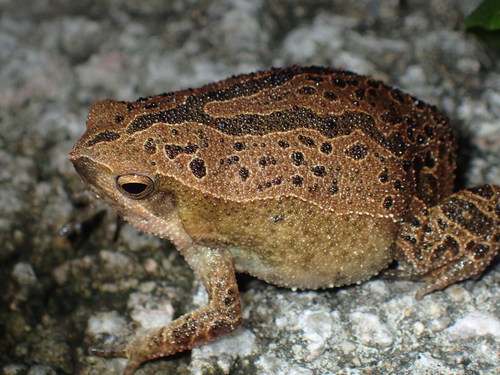
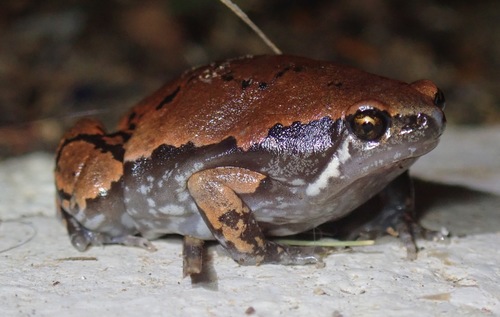
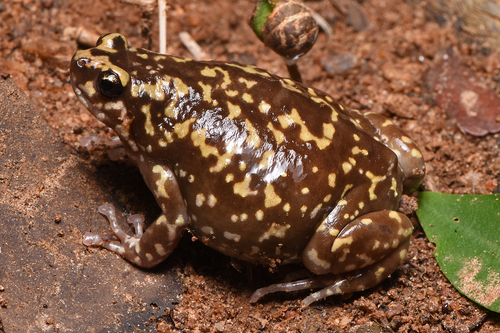
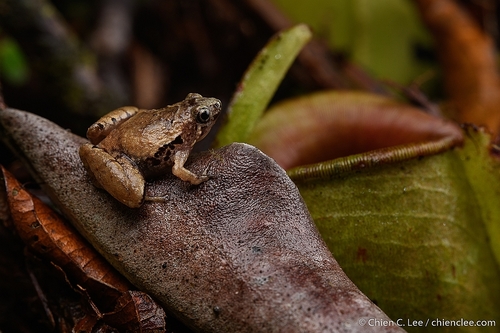
Microhyla borneensis is a very small frog species. Females have a snout–vent length of approximately 18 mm (0.71 in), while males are around two-thirds this size. Its body is broadly triangular and flattened from the dorsal to ventral side. The snout is obtusely pointed, the eyes are small with round pupils, and no tympani are visible. The dorsal skin can be either smooth or covered in tubercles, and the ventral skin is always smooth. Its limbs are short. The hands are unwebbed, and the outer digits are spatulate. The foot digits are partially webbed; M. borneensis has less foot webbing than most frog species, a trait that may help it climb the slippery sides of pitcher plants. The frog's dorsal surface is reddish-brown, its throat is mottled brown, and its ventral surface is pale. This species is known to occur in the Matang Range in Sarawak, Borneo, and is also found near Mount Serapi in Kubah National Park, Sarawak, Borneo. It is presumed to be widespread across suitable lowland habitats in northern Borneo. It spends much of its life cycle inside the traps of the pitcher plant Nepenthes ampullaria, and is classified as a nepenthebiont. This habitat is shared with the crab spider species Henriksenia labuanica, which is also commonly found in Nepenthes pitchers. This spider's former scientific name Misumenops nepenthicola, along with the specific epithet of the related Singapore species Henriksenia nepenthicola, uses the name "nepenthicola" to reflect this shared pitcher plant habitat. Microhyla borneensis breeds in the water-filled pitchers of Nepenthes ampullaria, a pitcher plant common on the floor of Borneo rainforests. Multiple clutches of eggs may be laid in the same pitcher, which can hold tadpoles of different ages. Metamorphosis occurs approximately two weeks after eggs are laid.