About Microhodotermes viator (Latreille, 1804)
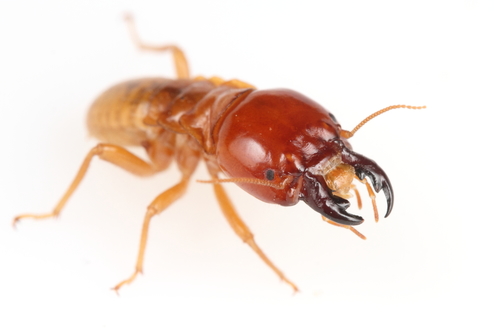
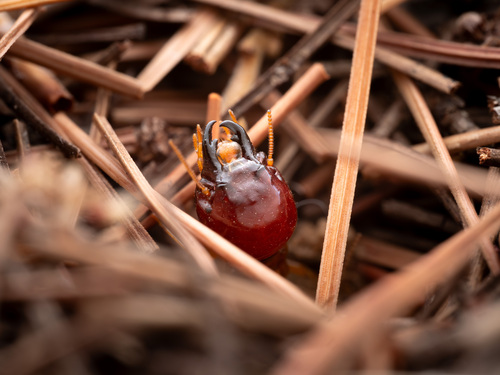
Microhodotermes viator was first collected and described by Pierre André Latreille in 1804. The species' holotype has a distinct red-brown head that is 3.8 mm wide. The unusually large head of M. viator is a unique feature among members of the Hodotermitidae family. Sharply defined, bright yellow pseudo-ocelli are located on this species' head. Its body is opaque yellow-orange, with a dark band in the transverse furrow of the prothorax, and its legs are pale yellow. Claude Fuller gave an alternate description of the legs as brown or red-brown, with yellow tarsi, and yellow tips on the tibiae and femora. Latreille described M. viator larvae as having a light brown body, a large brown head, distinctly faceted black eyes, and yellow ocelli. This species is polymorphic, with different physical forms corresponding to different colony castes, and is also sexually dimorphic. Males are typically larger than females. Soldier termites of this species have long, thin jaws that curve inward only at their tips, and reach body lengths of 7 to 13 mm. Worker M. viator have indistinctly striped brown abdomens, and body lengths between 6 and 8 mm. Alates have an average body length of 14.01 mm. Microhodotermes viator occurs in South Africa and Namibia, particularly along the west coast. It lives primarily in scrubland habitats that receive between 125 and 750 mm of annual precipitation. The full precise range of this species has not been mapped. M. viator colonies found in Namaqualand inhabit a warm, dry climate, where there are no perennial rivers.