About Microeca fascinans (Latham, 1802)
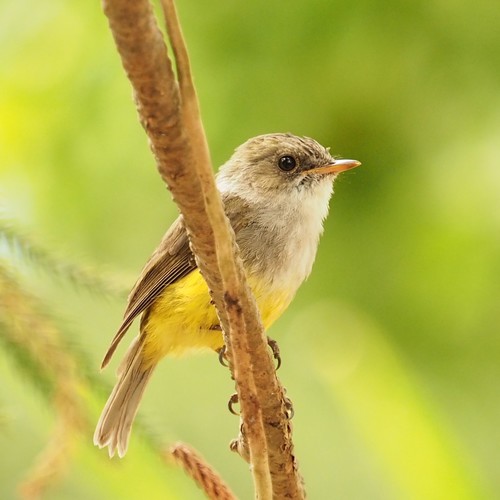
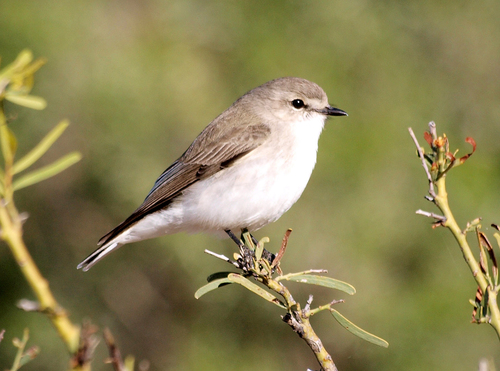
The jacky winter (Microeca fascinans) measures 12 to 14 cm long including its tail, and weighs between 14 and 18 grams. For the nominate subspecies M. f. fascinans, plumage features a greyish breast that is white on the lower half, with greyish-brown head and back, and darker brown wings edged in white. The bill is black, with a narrow eye-line and a buff alula stripe. Its tail is blackish brown with white outer feathers, and its legs are black. Subspecies M. f. assimilis is very similar to M. f. fascinans, but is darker overall, with more grey covering the breast and flanks that obscures the white visible on the nominate subspecies. Subspecies M. f. pallida is smaller than the other two subspecies, reaching only around 13 cm in length. It is much paler than the other subspecies, and typically has a sandy brown colour.
Jacky winters belong to Petroicidae, the family of Australasian robins and flycatchers. This family contains around 49 species across roughly 19 genera, all endemic to Australasia. The Petroicidae family evolved in a similar pattern to Australo-Papuan warblers (family Acanthizidae): Acanthizidae evolved in isolation from ecologically similar families Parulidae and Sylviidae, which occupy comparable niches in Central/South America and Eurasia, respectively. Petroicidae evolved in the Australo-Papuan region to fill an ecological niche that is filled by New World flycatchers (Tyrannidae) in the Americas, and by Old World flycatchers (Muscicapidae) in Europe, Africa, and Asia. This pattern is an example of convergent evolution.
The generic name Microeca comes from Greek words meaning 'small' and 'house', referring to this bird building the smallest nest of any Australian bird. The specific epithet fascinans is Latin for 'fascinating', derived from the Latin verb meaning 'to bewitch'. In addition to jacky winter, other common names for this species are brown flycatcher, peter peter, postboy, spinks and stumpbird. There are three subspecies of jacky winter found across Australia: the most widespread and familiar nominate M. f. fascinans (leucophaea) occurs in central and eastern Queensland, New South Wales, Victoria, and southeastern South Australia; M. f. assimilis is found in South Australia and south Western Australia; and M. f. pallida occurs in northern and western Queensland, the Northern Territory, and the Kimberley region of Western Australia. An additional subspecies, M. f. zimmeri, is found in Papua New Guinea.
Unlike many bird species where males have bright, flamboyant plumage to attract mates, the jacky winter is sexually monomorphic, meaning males and females are nearly identical in appearance. Instead of using plumage to attract mates, male jacky winters use song to attract females during courtship. In eastern Australian states, jacky winters mostly breed west of the Great Dividing Range, where suitable eucalyptus woodland habitat is available. They build a small, open cup-shaped nest from grass and bark strips bound together with spider webs. The nest is placed in an exposed position, usually on the fork of a tree branch.
The jacky winter breeding season runs from September to November. Male singing reaches its peak before September; once nestlings hatch in late September, singing drops to very low levels. Singing increases again in late October, continuing until early November, when females lay a second clutch for the breeding season. After the second clutch of young hatches in late November, males stop singing almost entirely, and vocalisations remain rare until the birds leave the area. Incubation lasts 16 to 18 days, and the total nesting period is 15 to 20 days. Only the female incubates the eggs, but the male helps feed newly hatched young. 92% of clutches contain exactly two eggs; clutch size rarely varies, as multiple environmental factors adjust egg count to maximize the survival rate of fledglings leaving the nest.
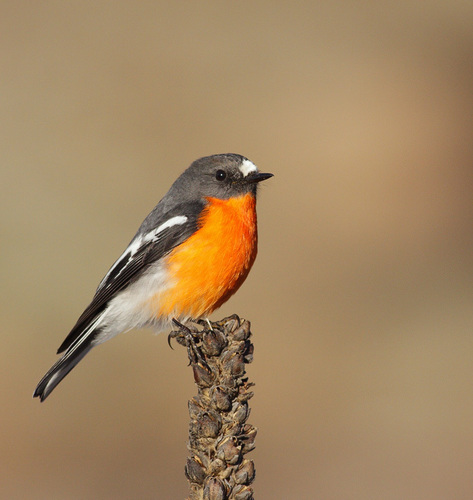
Recorded jacky winter territory size is 1.7 hectares, which is similar to other Petroicidae species such as the flame robin and scarlet robin. Jacky winters prefer breeding habitats that include eucalyptus box woodland or open box woodland, with patches of box trees and scattered isolated living trees. They also favour breeding sites that have fallen logs and stumps. Males maintain their territories by perching on top of eucalyptus trees and giving regular, sustained calls. Breeding density for jacky winters is approximately one pair per 17.2 hectares. Jacky winters defend their territories year-round.