About Microcebus murinus (J.F.Miller, 1777)
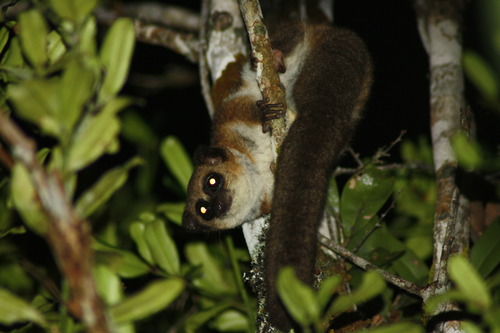
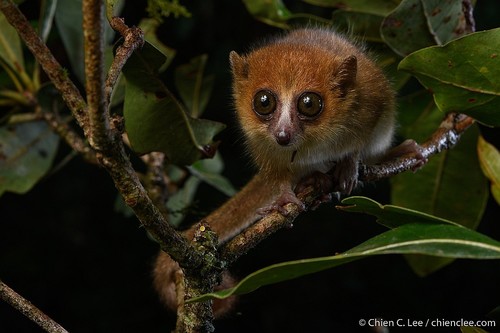
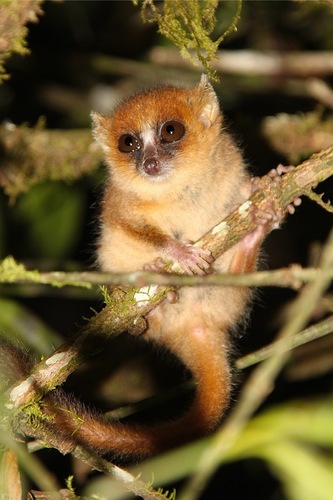
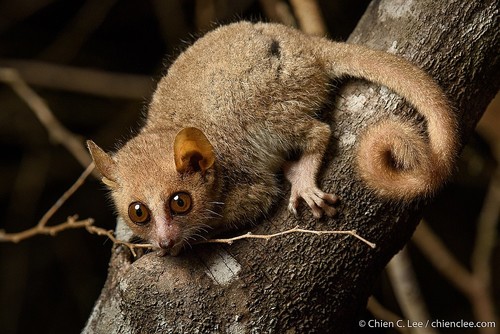
The gray mouse lemur (Microcebus murinus), also spelled grey mouse lemur or called lesser mouse lemur, is a small strepsirrhine primate lemur found only on the island of Madagascar. Weighing 58 to 67 grams (2.0 to 2.4 oz), it is the largest species in the mouse lemur genus Microcebus, a group that includes the smallest primates on Earth. Its name comes from its mouse-like size and coloration, and it has multiple local Malagasy common names: tsidy, koitsiky, titilivaha, pondiky, and vakiandry. Gray mouse lemurs and all other mouse lemurs are classified as cryptic species, as they are almost impossible to tell apart by external appearance. For this reason, gray mouse lemur was long considered the only existing mouse lemur species, until more recent research began to differentiate between separate species in the group. Like all mouse lemurs, this species is nocturnal and arboreal. It is very active; while it forages alone, groups of males and females form shared sleeping groups and share tree holes during the day. During cool, dry winter months, it enters a form of dormancy called torpor, and in some cases undergoes seasonal torpor (also called hibernation), a trait that is unusual for primates. The gray mouse lemur lives in several types of forest across western and southern Madagascar. Its diet consists mainly of fruit, insects, flowers, and nectar. In the wild, its natural predators include owls, snakes, and endemic mammalian predators. This species faces higher predation pressure than any other primate species, with one out of four individuals killed by a predator each year. This high mortality is balanced out by the species' high reproductive rate. Breeding is seasonal, and the species uses distinct vocalizations to prevent hybridization with other species that share its range. Gestation lasts approximately 60 days, and most litters produce two young. Offspring are usually independent after two months, and can reproduce after one year. The gray mouse lemur has a reproductive lifespan of five years in the wild, while captive individuals have been reported to live up to 15 years. Although it is threatened by deforestation, habitat degradation, and live capture for the pet trade, it is considered one of the most abundant small native mammals in Madagascar. It can tolerate moderate food shortages by entering daily torpor to conserve energy, but extended food shortages caused by climate change may pose a significant risk to the species. Like all other members of the family Cheirogaleidae, the gray mouse lemur is nocturnal and arboreal. It can live in a wide range of habitats: lowland tropical dry forest, sub-arid thorn scrub, gallery forest, spiny forest, eastern littoral forest, dry deciduous forests, semi-humid deciduous forest, moist lowland forest, transitional forest, and secondary or degraded forests including plantations. All of these habitats occur up to 800 m (2,600 ft) above sea level. The species is more common in secondary forest than primary forest, especially in bush and scrub habitat, where it occupies a "fine branch" niche that limits its vertical range to fine branches, fine terminal supports, lianas, and dense foliage. These lemurs are usually found on branches less than 5 cm (2.0 in) in diameter. The gray mouse lemur generally prefers lower forest levels and the understory, where branches and vegetation are dense. In secondary forest, it is typically seen from ground level up to 10 m (33 ft) above ground, while it occurs 15 to 30 m (50 to 100 ft) up in the canopy of primary forest. Studies have found the species can spend as much as 40% of its time below 3 m (10 ft), and 70% of its time at this level at the end of the dry season, when plant food is scarce and insects make up a larger share of its diet. The species is more numerous in spiny forest, such as the Andohahela Special Reserve, than in gallery forest, and prefers drier, littoral forest, while the brown mouse lemur prefers inland rain forest. The limits of the gray mouse lemur's distribution are not well understood. It is thought to range from the Onilahy River or Lake Tsimanampetsotsa in the south to Ankarafantsika National Park in the north. There is also an isolated, disconnected population in the southeastern part of Madagascar, near Tôlanaro and Andohahela National Park, extending up to the Mandena Conservation Zone. Individual gray mouse lemurs typically occupy small home ranges of 1 to 2 ha (2.5 to 4.9 acres). The gray mouse lemur shares its range with the reddish-gray mouse lemur, golden-brown mouse lemur, Madame Berthe's mouse lemur, and several other cheirogaleid lemurs. In Ankarafantsika National Park, where it coexists with the golden-brown mouse lemur, gray mouse lemur reaches its highest relative population density at higher altitudes and in drier habitat, while the golden-brown mouse lemur prefers the opposite conditions. A study of coexistence between the gray mouse lemur and Madame Berthe's mouse lemur found small, exclusive clusters of each species and a high degree of overlap in feeding niches. The gray mouse lemur can reach high population densities of up to several hundred individuals per square kilometer: up to 167 individuals/km² at Ankarafantsika National Park, and up to 712 individuals/km² at Kirindy Mitea National Park. This abundance is not uniform, and tends to be concentrated in "population nuclei", which means extrapolating population density estimates from small study areas to larger regions often produces inaccurate results. The difficulty of finding individuals during parts of the year, especially during dry periods, further complicates accurate population density estimation. Mouse lemurs are omnivorous, and fruit and insects make up most of their diet. The gray mouse lemur may even descend to the ground to catch insect prey, though it quickly returns to the protective cover of the understory to eat its catch. Nectar is also part of the gray mouse lemur's diet, making it a potential pollinator for local plant species. A single confirmed case of a male gray mouse lemur cannibalizing an adult female has been recorded. The gray mouse lemur's mating system is described as multi-male and multi-female. Males establish dominance hierarchies before the mating season, but some wild studies have found no male aggression or visible competition for receptive females. Captive males become highly aggressive and form strict dominance hierarchies. These captive males can have the highest plasma testosterone levels recorded in mammals, and even the scent of a dominant male can lower testosterone levels and sexually inhibit subordinate males. During the mating season, male testes increase significantly in size, which supports sperm competition due to female promiscuity. Studies of gray mouse lemurs have shown that the optimal period for insemination, when a male is most likely to sire offspring, occurs early in a female's receptive period. Male mortality only rises above female mortality during the mating season. Even though the gray mouse lemur follows multi-male, multi-female mating patterns, studies have shown females practice indirect mate selection, a form of selected polyandry. In one study, females mated with 1–7 males up to 11 times during their single night of receptivity, but would avoid or counteract males that attempted to monopolize mating. Dominant males that attempt to monopolize mating tend to be larger and heavier individuals. However, female selection has been shown to increase genetic diversity among offspring. The gray mouse lemur is overall sexually monomorphic, but seasonally fluctuating sexual dimorphism in body mass has been recorded. While the body mass of both sexes changes over the year based on food availability, reaching its highest point in the rainy season, the different behaviors of each sex lead to sex-specific patterns in this fluctuation. For example, male body mass increases before the mating season due to a substantial increase in testes volume, which likely improves males' success in sperm competition. Females are receptive for 45 to 55 days between September and October, with estrus lasting 1 to 5 days. Females signal estrus with distinctive high-frequency calls and scent-marking. Gestation lasts 54 to 68 days, with an average of 60 days, and most litters produce 2 or 3 offspring that each weigh 5 g (0.18 oz). Infants are born in a leaf nest or tree hole in November, before the rainy season begins. Weaning occurs after 25 days. While the mother forages, she either leaves infants in the nest or carries them in her mouth to deposit them on a branch. Infant mouse lemurs do not cling to their mother's fur. Offspring gain independence after 2 months. Sexual maturity is reached between 10 and 29 months in females, and between 7 and 19 months in males. Closely related females remain loosely associated after reaching maturity, a pattern called female philopatry, while males disperse away from their natal area. In the wild, the gray mouse lemur's reproductive lifespan is no more than 5 years, while captive specimens have reportedly lived as long as 15 years and 5 months, or even up to 18.2 years. The gray mouse lemur uses cooperative breeding as a form of family insurance. Females regularly move their own offspring to other females' nests, and will also groom and care for offspring that are not their own. While this can have a high physiological cost for a lactating female already expending large amounts of energy, it is overall beneficial for ensuring survival in closely related groups that face high mortality risk. A study conducted over three breeding seasons found that closely related females form breeding groups mainly when there is a shortage of suitable roosts. These groups also form when communal nesting provides advantages for defense, or when it offers thermoregulatory benefits. When a parent dies and a closely related female takes over care of the orphaned offspring, this is thought to benefit groups that face high mortality risk.