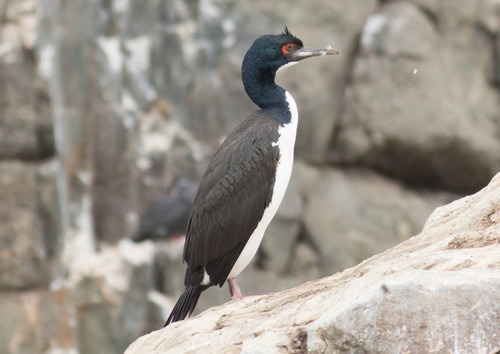
About Microcarbo pygmaeus (Pallas, 1773)
The pygmy cormorant, with the scientific name Microcarbo pygmaeus (Pallas, 1773), is a member of the Phalacrocoracidae cormorant family of seabirds. It breeds in southeastern Europe and southwestern Asia. It is partially migratory: northern populations winter further south, mostly within the species' existing breeding range. It occurs as a rare vagrant in western Europe. The pygmy cormorant's range extends from southeastern Europe, east of Italy, to southwestern temperate Asia, reaching as far east as Kazakhstan, Tajikistan, Turkmenistan, and Uzbekistan. The largest portion of its range is in southeastern Europe, including Albania, Greece, Bulgaria, Romania, the Balkan countries, Turkey, Cyprus, Iran, Iraq (specifically the Tigris–Euphrates river system), Azerbaijan, Palestine, and Syria. In Romania, studies by Czech ornithologist Robert Ritter von Dombrowski recorded that at the end of the 19th century, the pygmy cormorant formed large colonies in the Danube Delta, Brăila and Ialomița Pond, on Vederoasa Lake in Constanța County, and on certain reed- and willow-bordered pools and ponds in Muntenia. The total counted number of breeding pairs was 10,000, not including the additional breeding population in the Danube Delta. Pygmy cormorant populations in Romania have declined dramatically, especially in 1960. At that time, communist agricultural policies led to the draining of Great Brăila Island and large parts of Ialomița Pond to convert the land to agriculture, which destroyed the habitats of many species of aquatic birds, including the pygmy cormorant. Today, the pygmy cormorant can be found in Romania in the Danube Delta, Jijia Largă Pond in Iași County, and possibly on Mața, Rădeanu, and Vădeni Ponds in Galați County, Cârja Pond in Vaslui County, at Vlădești on the Prut River in Galați County, on Calinovăț Island in Caraș-Severin County, on Small Brăila Island, on Dunăreni Pond near Mârleanu in Constanța County, and at Parches Pond-Somova in the Danubian Plain, Tulcea County. At the global scale, a 2006 study by Wetlands International estimated the entire global pygmy cormorant population to be between 85,000 and 180,000 individuals, with 74 to 94 percent of the total global population living in Europe. The largest single colony of the species is located in the Danube Delta, and holds 4,000 breeding pairs. However, this colony is almost certain to see a steep population decline, because a massive canalization project began in the delta in May 2004 despite the area's protected status. A 2004 study by BirdLife International estimated the pygmy cormorant population in Romania to be between 11,500 and 14,000 breeding pairs, with between 1,500 and 4,000 overwintering pairs. Pygmy cormorants prefer pools with abundant vegetation, lakes, and river deltas, and avoid mountainous, cold, and dry areas. They are often found in rice fields or other flooded areas that have trees and shrubs. During the winter, they also use higher-salinity waters, estuaries, and barrier lakes. This species may live alone or in groups, and has adapted to living near human activity. They build their nests from sticks and reeds in dense vegetation, located in trees, shrubs, or willows; occasionally, they will nest in reeds on small floating islets. Breeding occurs from late May to early June. Both parent birds incubate the eggs for 27 to 30 days, and nestlings become independent 70 days after hatching. Parents feed their young small fish and other aquatic animals. The pygmy cormorant frequently shares its preferred habitat with egrets, herons, and spoonbills.