About Micrathena raimondi (Taczanowski, 1879)
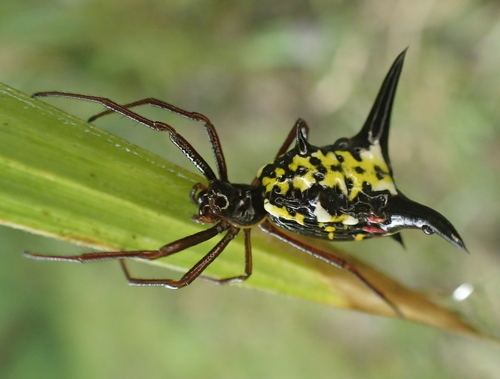
Micrathena raimondi, first described by Taczanowski in 1879, is sexually dimorphic like its related species, with females reaching larger sizes than males. For females, the carapace is brown, with a light eye region and light-colored thorax; the sides of the thorax are dark, and marked with light-colored rims. The sternum is dark brown, and the legs have brown coxae and brown distal segments. The abdomen has a distinctive black longitudinal band on each side between its spines, with white spots located on the abdomen sides. No white spots are present in the middle section between the epigynum and spinnerets. The female carapace has a deep transverse groove, a narrow rim, and no dimples. Females of this species typically measure 10.4 mm in total body length, with a carapace length of 3.0 mm. Males are considerably smaller than females and have different coloration. Males have an orange carapace with brown sides, and a dark brown sternum. Their abdomen is speckled with white, and has dark marks on its corners and venter. Males measure 5.6 mm in total body length, with a carapace length of 2.6 mm. This species is known to occur in Peru and Ecuador. In Peru, it has been recorded in the Department of Cajamarca, including its type locality near Nancho at 3,600 feet elevation. In Ecuador, specimens have been collected from Provincia Pichincha, at elevations between 1,300 and 1,500 meters.