About Micrastur ruficollis (Vieillot, 1817)
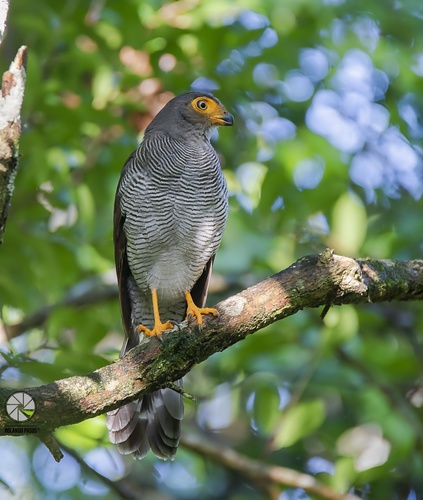
The barred forest falcon (Micrastur ruficollis) measures 31 to 39 cm (12 to 15 in) in length. Males weigh 144 to 184 g (5.1 to 6.5 oz), while females weigh 200 to 322 g (7.1 to 11.4 oz). For most subspecies, adult plumage is typically dark slate gray on the upperparts. The tail is tipped with white and marked with three to six narrow white bars. The throat is pale gray, darkening to match the slate tone of the crown. The rest of the underparts, including under-wing coverts, are white with fine, clear black or dark gray barring, and the upper breast is a darker gray. Primary flight feathers are dark brownish-gray, with off-white bars on their inner webs. The subspecies M. r. zonothorax is polymorphic, at least across the northern part of its range, and also has a brown morph where most of the upperparts, head, and chest are brown or rufous instead of gray. The nominate subspecies M. r. ruficollis appears to only occur in the rufous-brown morphotype, as suggested by its scientific name. The eyes range from cream to light orange brown; the bill is black, turning yellow at the base of the lower mandible; the cere, lores, and orbit are yellow, and the legs are orange-yellow. Different subspecies of the barred forest falcon occupy distinct ranges: M. r. guerilla ranges from San Luis Potosí in central Mexico south to Nicaragua, excluding the Yucatán Peninsula and El Salvador; M. r. interstes ranges from Costa Rica south through Panama, western Colombia, and western Ecuador into extreme northwestern Peru; M. r. zonothorax is found in the Venezuelan Coastal Range, the Serranía del Perijá on the Venezuela-Colombia border, Colombia's Sierra Nevada de Santa Marta and Cordillera Oriental, and extends south in the foothills along the east side of the Andes through Ecuador and Peru into Bolivia; M. r. concentricus occurs in southern Venezuela, the Guianas, and the Amazon Basin of Brazil; M. r. ruficollis is found in Brazil south of Amazonia, Paraguay, and the Formosa, Chaco, and Misiones provinces of north-central and northeastern Argentina; M. r. olrogi is restricted to the Jujuy, Salta and Tucumán provinces of northwestern Argentina. Barred forest falcons primarily inhabit mature upland forest. In Central America, the species is generally limited to mature tropical forest. However, in South America, it occurs in a variety of forest and woodland types, even relatively arid ones. In the Amazon biome, for example, it is most often found in secondary forest, gallery forest, tidal swamp forest, semideciduous forest, and forest edges. In Acre, Brazil, the barred forest falcon is reported to prefer disturbed forest types, both natural secondary and human-created, including bamboo stands and more open seasonally drier forest on rocky outcrops. Despite this tolerance for some disturbance, it generally avoids habitats where human influence is too strong, and requires primary or mature secondary forest to persist at any location. The barred forest falcon is rare on the eastern slope of Colombia's Cordillera Oriental, where it has been recorded in primary forest and old secondary forest within a narrow elevational band between 3,300 and 4,900 m (10,800 and 16,100 ft). In these mountains, second-growth forest is dominated by trees in the Melastomaceae family, such as Miconia and Tibouchina, and trees are generally overgrown with epiphytes and hemiepiphytes like Coussapoa from the Urticaceae family.