About Micrarchus hystriculeus (Westwood, 1859)
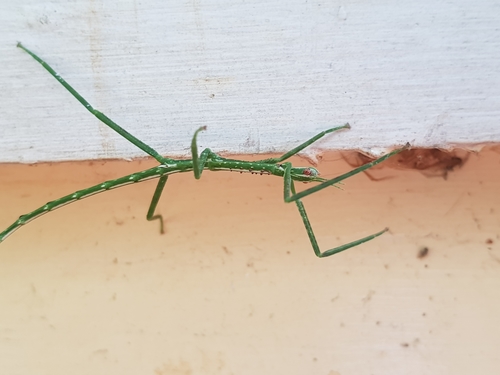
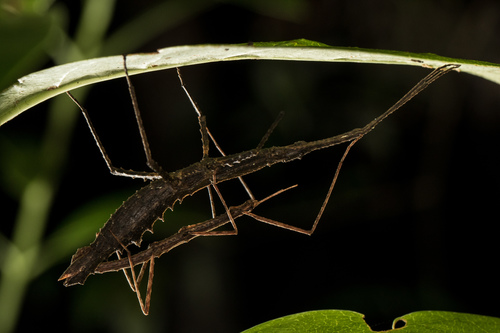
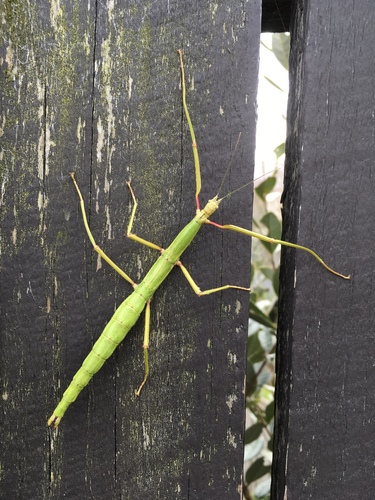
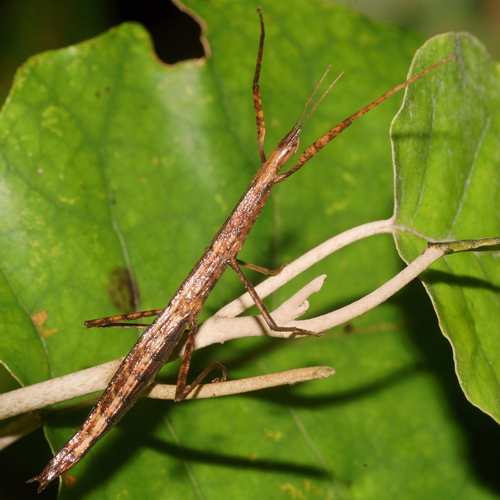
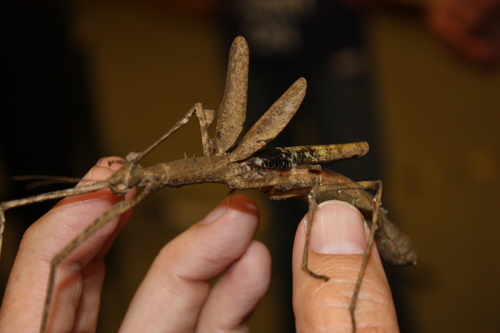
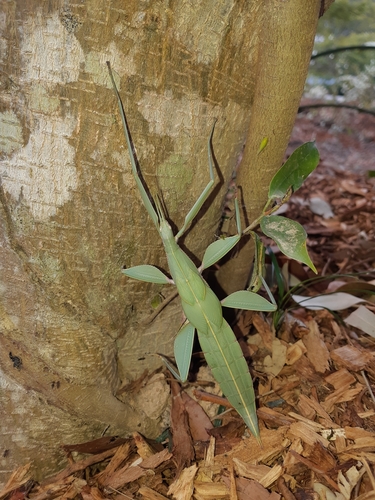
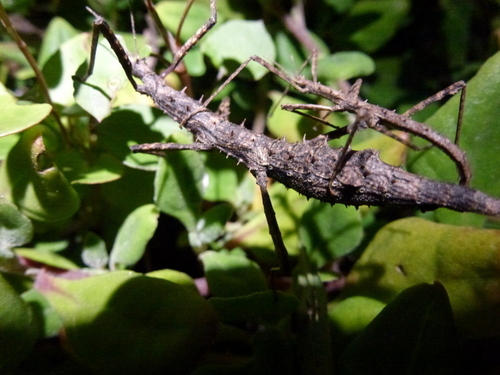
Micrarchus hystriculeus (Westwood, 1859) is a wingless (apterous) stick insect that displays sexual size dimorphism: adult females are larger than males, growing to over 56 mm in length, and have proportionally longer mid and hind legs that support their larger abdomens. Males measure less than 50 mm in length, and have elongated tong-like claspers that bear a series of black teeth; these claspers are used to grasp females during copulation. This generally small species is brown in color, with two rows of spines along its back and spiky flanges on its legs. Its eggs are distinctive and used for species identification: they lack spine-like setae, and their capsules are 1.7–2.4 times longer than they are broad. Eggs also have a prominently steeply rising keel, and a very short, flatly conical, sharply pointed capitulum (a knob-like structure). Key identification features for this species differ by sex. For females: cerci are distinctly shorter than the anal segment, and do not reach the tip of the anal segment; metatarsals of the mid and hind limbs do not have a dorsal lobe; the operculum extends up to halfway along the anal segment. For males: claspers form elongated tong-like pinchers with separate black teeth; dorsal abdominal spines are located on the anterior margin of each tergite. This species is widely distributed across New Zealand, and is the only member of its genus found on the North Island. It inhabits lowland arboreal habitats and is considered an ecological generalist. While it can be found in alpine areas, it is less cold-hardy than other species in the Micrarchus genus. Micrarchus hystriculeus is a herbivorous stick insect that feeds on mānuka, ribbonwood, and Hoheria. During mating, the male mounts the female's back, curves his abdomen down and around the female's body, and grasps the operculum tightly. This species practices prolonged pairing, which is thought to act as mate guarding. Males compete in grappling contests, where competing males attempt to dislodge a male that is already mounted on a female. Populations of this species have a male-biased sex ratio, and unpaired females are rarely observed. Physiological research shows that this species can survive low temperatures through supercooling, but is not fully freeze tolerant. Compared to alpine Micrarchus species, this lowland species has a significantly low survival rate of less than 50% when ice is present. It uses a cold tolerance strategy called freeze avoidance, which prevents internal ice formation.