About Metridium senile (Linnaeus, 1761)
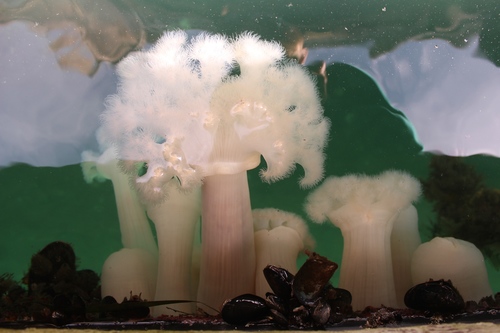
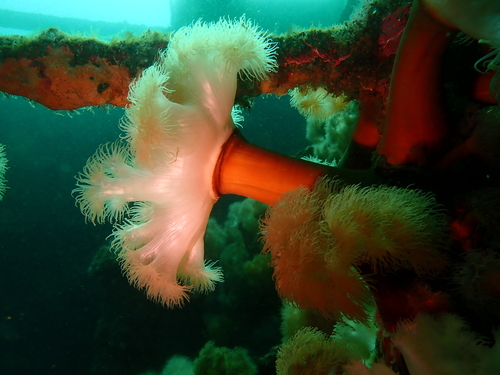
The base of Metridium senile is considerably wider than its column, and anchors the organism to rock or another substrate. The column itself is long, smooth, and cylindrical, with a fleshy consistency and a slimy surface coated in mucus. It has no warts or suckers, and is topped by a parapet above a deep groove. The oral disc is broad and deeply lobed into several curving sections that overhang the column. Tentacles are slender and pointed; larger specimens have very numerous tentacles, while smaller specimens have fewer, relatively longer tentacles. Tentacles near the margin of the oral disc are crowded and short, while tentacles closer to the center of the disc are longer and more spaced out. This sea anemone has a wide range of possible body colors, but any single individual is uniformly colored across its body, except for the orange-red lip that surrounds the central mouth. Recorded colors include white, cream, pink, orange, red, grey, brown, and olive-green. The tentacles are translucent, and may have a white band; some specimens have a darker column and a much paler disc. There are several distinct forms of Metridium senile, along with various intermediate types. M. senile var. dianthus matches the general description above, has over 1000 tentacles, and has a feathery overall appearance. It can grow to 30 cm (12 in) tall, with a base diameter of 15 cm (6 in), and a tentacle span of a similar size. M. senile var. pallidus is much smaller, with a base diameter that seldom exceeds 2.5 cm (1 in). It has a much less convoluted oral disc, and fewer than 200 tentacles. This variety appears to be a dwarf race that becomes sexually mature while it is still small. A number of other intermediate forms also exist. Naturalist Johannes Peter Müller described the variety dianthus as "the most beautiful of all the anemones". When its tentacles are fully expanded, it is indeed an impressive sight, resembling a palm tree. When retracted, it becomes a low, irregularly shaped, jelly-like disc with an unattractive appearance. When exposed to air by a retreating tide, it does not always retract; it may hang limply under an overhang, looking like a wet glove with a single drop of water dangling from its tip. Metridium senile is found on the northwest coasts of Europe, ranging from the Bay of Biscay north to Norway and Iceland. It also occurs on the east and west coasts of North America, and has been recorded in South African waters. It inhabits the lower shore and the neritic zone, at depths down to approximately 100 m (328 ft). Metridium senile attaches to rocks, boulders, man-made structures, pebbles, and shells. It prefers locations with strong currents. Smaller forms live on the lower shore, where they occur under stones, beneath overhangs, and in shaded places. It specifically favors soft rocks honeycombed by molluscs, and the underside of large boulders. At greater depths, larger forms are sometimes abundant on pilings, submerged pipes, pier supports, and harbour walls. In the English Channel, these anemones are often brought up when trawling for oysters and scallops in shallow waters; one oyster was recorded with twenty anemones crowded onto its shell.