About Metridium farcimen (Brandt, 1835)
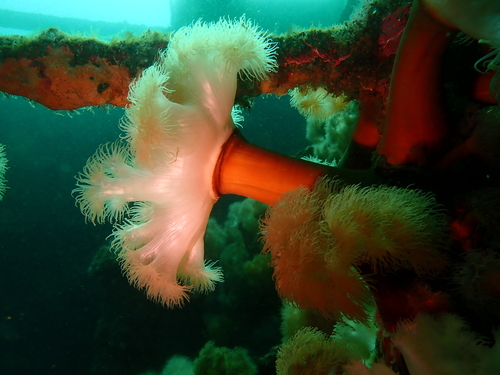
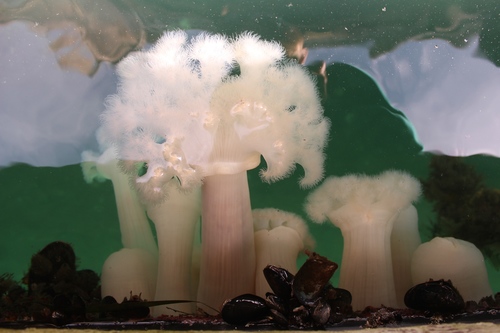
Metridium farcimen is a large sea anemone species. When fully extended, it can occasionally reach a height of 1 metre (39 in), though most fully extended individuals are 50 cm (20 in) or shorter. This species has highly variable shape, and can retract its tentacles to form a ball up to 25 cm (10 in) in diameter. Its column is slender and smooth, studded with acontia: openings that allow thread-like nematocysts from inside the body wall to protrude. There are no tubercles on the column, which is topped by a parapet. The oral disc is lobed and deeply convoluted at the edge, and bears well over 100 fine, short, tapering tentacles. Its body color is generally opaque white, but orange, salmon, and brown specimens occur occasionally. Large individuals develop long, thick fighting tentacles, which are used to drive away other anemones that attempt to settle too close. Some individuals growing on the edge of large colonies have several of these fighting tentacles on their lips, which they use to repel non-clonal anemones. These clonal colonies develop from a single original individual through asexual cloning. Metridium farcimen may be confused with Metridium dianthus, a related species that occupies the same habitat and has a similar color and general form. However, M. dianthus seldom exceeds 10 cm (4 in) in height, has fewer than 100 tentacles, and has an unlobed oral disc. Metridium farcimen is found along the western seaboard of the United States and Canada, with a range extending from Alaska southward to California. It is most common in Puget Sound and around Vancouver Island. It occurs in the sublittoral zone, where it grows on rocks, mollusc shells, pilings, docks, and other human-made structures, and can even survive in polluted waters. It is also found at great depths, near hydrothermal vents, cold water seeps, and decomposing whale carcasses on the seabed.