About Metopidius indicus (Latham, 1790)
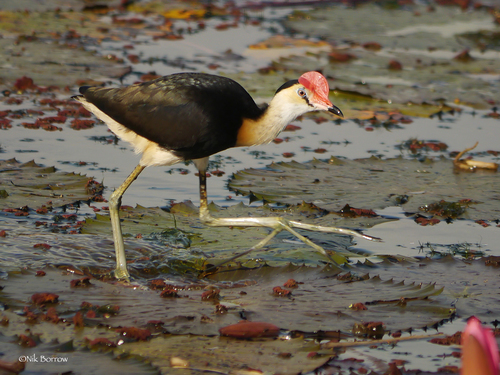
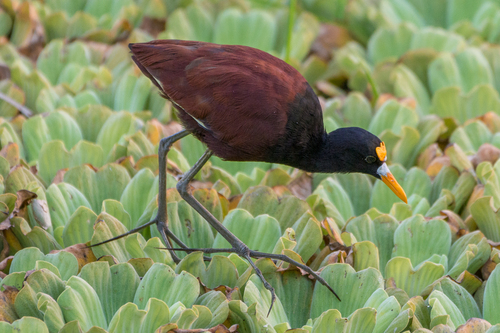
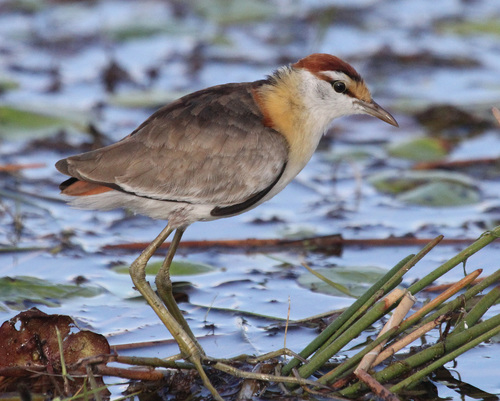
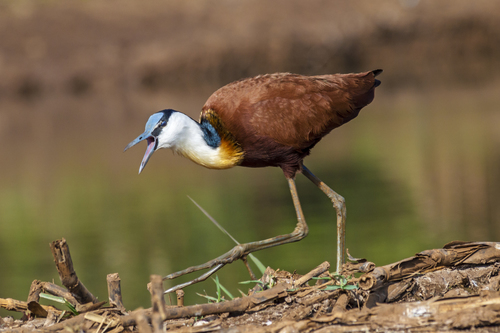
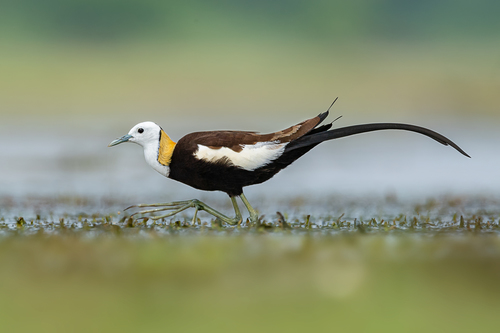
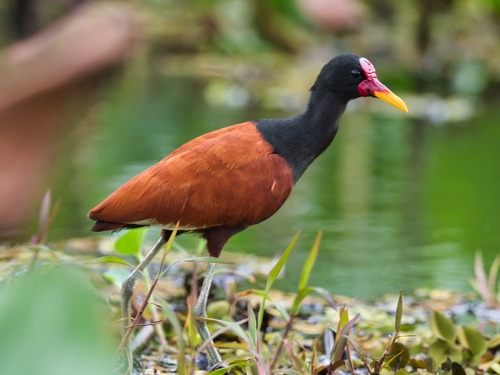
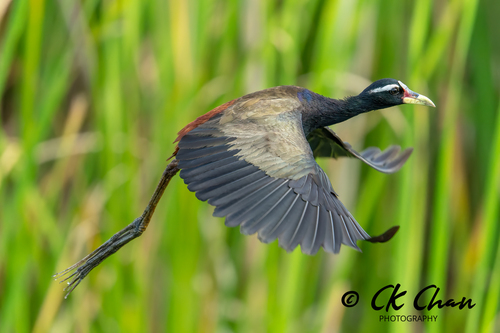
Bronze-winged jacanas (scientific name: Metopidius indicus (Latham, 1790)) are large, short-tailed, rail-like birds that appear dark when viewed from a distance, with the exception of their supercilium. They measure 29 cm (11 in) in total length. The plumage of males and females is similar, though females are slightly larger than males. Their wings are bronzy brown with a green sheen, and have a reduced tubercular carpal spur. Their head, neck, and breast are black, which contrasts with the broad white supercilium that runs from above the eye back to the nape of the neck. Their lower back and tail coverts are chestnut. The stubby tail is reddish brown with a black terminal band. Their greenish yellow bill has a red base on the upper mandible. A lappet, or frontal shield, extends up over the forehead and is reddish purple. Their legs are greenish, and their toes are long and straight; the elongated nail on the hind toe is longer than the toe itself. Downy chicks are light brown with a dark stripe running down the nape. Juvenile birds have brown upperparts, a rufous crown, white underparts, and a buff foreneck, with an undeveloped frontal shield, and may have a dull supercilium. At a distance, adult bronze-winged jacanas can be confused with common moorhens (which occupy similar habitat) and watercocks. While juvenile bronze-winged jacanas can look similar to juvenile pheasant-tailed jacanas, they lack the black necklace that young pheasant-tailed jacanas have. The species is widely distributed across the Indian subcontinent, excluding Sri Lanka and western Pakistan, and Southeast Asia, occurring mainly at low elevations. Both this species and the pheasant-tailed jacana can be found in the same habitat. Bronze-winged jacanas are mostly non-migratory, only making seasonal dispersal in response to drought and rainfall. They can use wetlands covered by introduced weeds such as water hyacinth, and use the cover provided by Ipomoea aquatica during breeding. Bronze-winged jacanas occur singly or in pairs while foraging on aquatic vegetation. They balance on their long legs and long toes, and feed on insects, other invertebrates, and incidentally consumed plant material, picked from floating vegetation or the water's surface. Their call is a wheezy piping seek-seek-seek, given most often when they are alarmed. When threatened, they sometimes hide by submerging their bodies. The breeding season begins after the rains; it falls between June and September in India, though occasional breeding following March rains has been reported in Rajasthan. Males defend territories against other males using displays with open wings and stretched necks, which can escalate to pecking. Territory maintenance activity reaches its peak between 9 and 11 a.m. The nest is a small platform made from stems and leaves of Pistia, Nymphoides, Hydrilla, and Eichhornia, placed on a mat of vegetation, but eggs may also be laid directly on the leaf of a lotus plant. The typical clutch size is four eggs. The eggs are distinctly conical, glossy brown with irregular black zig-zag markings. Incubation and care of young is done entirely by males. Eggs hatch after 29 days. Predation rates for eggs are high: one study recorded up to 94% of eggs lost to various predators including birds and turtles. Adult males may shelter young chicks between their wings and carry them to safety. Chicks become independent of their father when they are around ten weeks old. Nematode parasites Gongylonema indica and Stellocaronema alii, and the feather louse Rallicola indicus have been recorded from specimens of the bronze-winged jacana.