About Methona confusa Butler, 1873
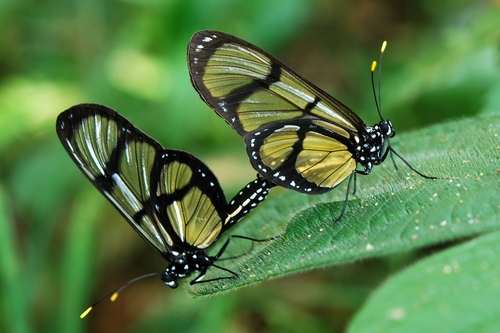
Methona confusa Butler, 1873 has a wingspan of approximately 11 centimeters. Its wings lack nanostructures, making them both transparent and reflective. Both forewings and hindwings have black margins and black cross-bars. On the underside of the wing margin, there are small white spots; white spots are also present on the species' abdomen and thorax. Its antennae are black with a yellow tip. M. confusa exhibits both Müllerian mimicry and Batesian mimicry through its wing features. This species is distributed across Brazil, Ecuador, Panama, Peru, Venezuela, Bolivia, Argentina, and Colombia, and is specifically found in the Amazon basin. Its population has been declining, a trend that may be caused by predation by ants and birds during the larval stage; during the pupal stage, the species is affected by parasitoid wasps in the family Eulophidae and fungi. M. confusa is most often found in montane forests and mountain ranges such as the Andes, at elevations up to 3,500 meters. It has also been recorded in less suitable habitats including wet grasslands and punas. It takes approximately 45 days for M. confusa to develop from an egg into a mature adult. White eggs are laid in clusters on the underside of leaves of Brunfelsia plants in the family Solanaceae. Some other species in the genus Methona are monophagous. M. confusa and M. curvifascia have very similar looking larvae: M. confusa has 12 stripes along its body, while M. curvifascia has 11. As an instar, M. confusa has dark brown and yellow stripes running transversely across its body. The pupa has a black cremaster; a few days before the adult emerges, the wing pads of the pupa are black and gold. The pupal stage lasts around 12 days. Mating in this species occurs in two distinct sequences performed by the male. In the first sequence, the male grabs the female and both fall to the ground. In the second sequence, the male leaps onto the female while in flight. M. confusa larvae exhibit gregarious behavior, and the species also displays summit congregation behavior.