About Metellina segmentata (Clerck, 1757)
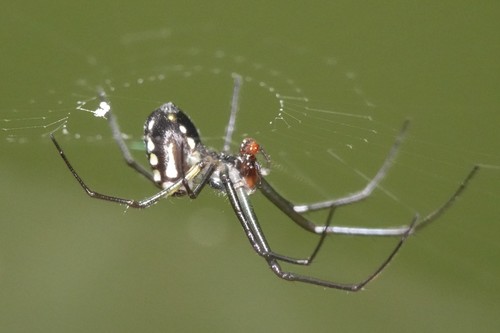
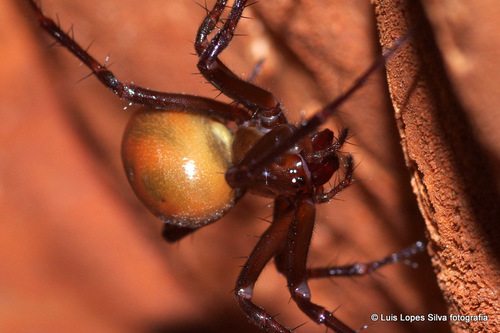
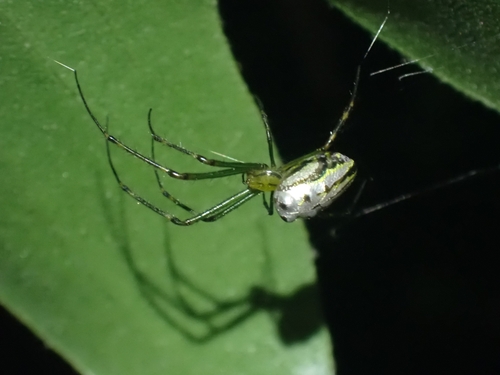
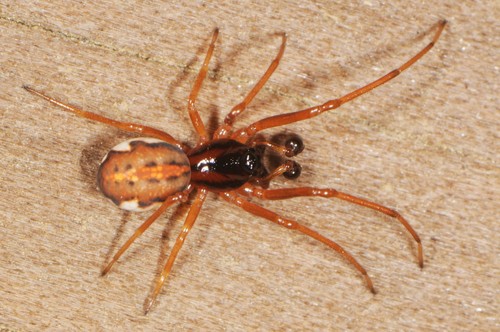
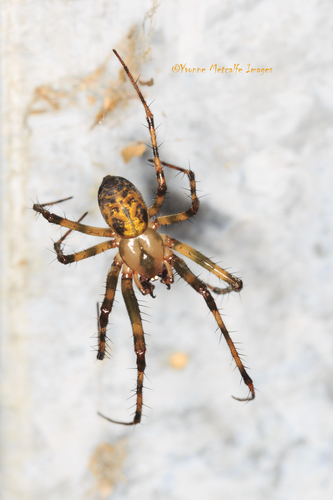
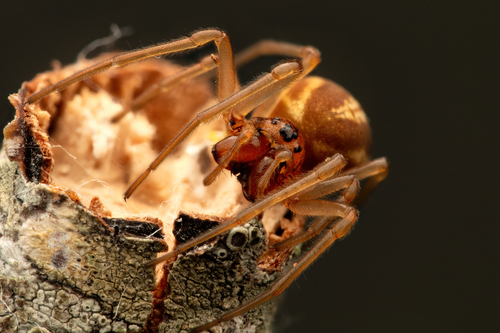
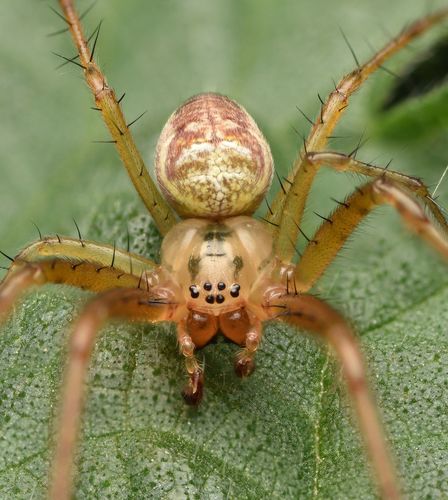
Metellina segmentata typically has yellow, red, and orange coloring on its abdomen, with a black fork-shaped mark at the center of the carapace. Its dorsal surface is pale cream, with tones of red and pink. Like many other spider species, this species shows considerable variation in both color and patterning. Females have a black strip on their underside that extends all the way to the end of the epigyne. When resting on grass, this spider stretches two legs forward, while the remaining six legs are held backward. Adult males usually measure 4 to 6 mm in body length, while females are slightly larger, ranging from 4 to 8 mm long. This species looks extremely similar to Metellina mengei, and the only reliable way to tell the two species apart is by examining their genitalia. Males of Metellina segmentata generally have longer legs and a larger prosoma, while females have a larger opisthosoma, the organ that produces and carries eggs. Both sexes, and females in particular, have powerful chelicerae. Compared to other spiders, Metellina segmentata has unusually large epigynes. Metellina segmentata is primarily found in the United Kingdom within Europe, and has recently also been recorded in Canada. These spiders prefer low, bushy habitats, though some live in areas with dense coverage of branches and leaves that provide extra protection. A spider's habitat depends on its size: larger individuals occupy higher-quality sites with good light and adequate wind flow, such as between tree branches and on leaves. Smaller spiders are pushed into lower-quality sites, including window corners and bushes, where light levels and opportunities for prey capture are relatively low. During the September mating season, multiple males wait in a female's web for prey to be caught. When an insect is captured, all the waiting males compete for it. The first male to reach the prey wraps it up, then presents it to the female, while also sending signals by plucking the threads of her web. The yellow eggs are laid on a twig or bark inside a spherical white cocoon. This reproductive process is very similar to that of the slightly smaller Metellina mengei, and the two species can only be distinguished by comparing their genital features.