About Metasequoia glyptostroboides H.H.Hu & W.C.Cheng
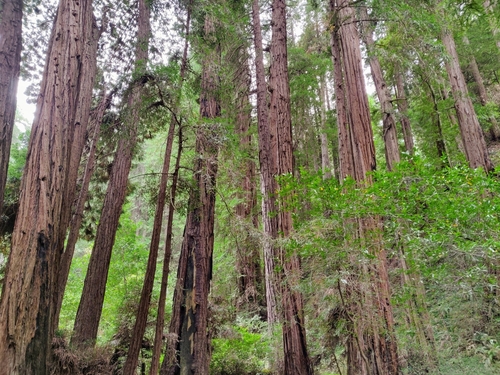
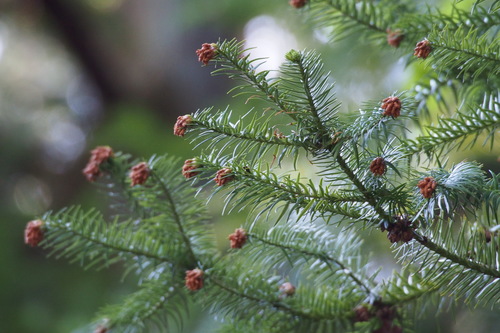
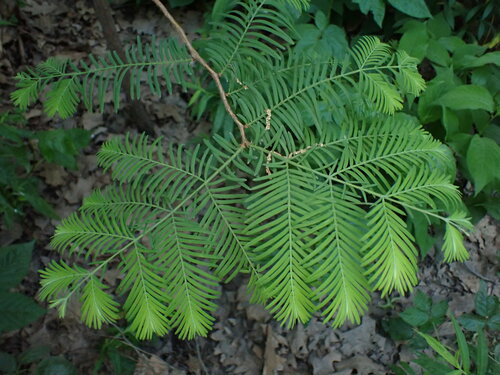
Metasequoia glyptostroboides, commonly called dawn redwood, has opposite leaves that measure 1–3 cm (0.39–1.18 in) long. The leaves are bright fresh green, and turn foxy reddish brown in autumn. Its pollen cones are 5–6 mm (0.20–0.24 in) long, produced on long spikes in early spring, and only grow on trees located in regions with hot summers. Its seed cones are globose to ovoid, with a diameter of 1.5–2.5 cm (0.59–0.98 in). The cones have 16–28 scales arranged in opposite pairs across four rows, where each pair sits at a right angle to the adjacent pair. Cones mature about 8–9 months after pollination. While M. glyptostroboides has bark and foliage similar to the closely related redwood genus Sequoia, it differs from coast redwood by being deciduous, just like Taxodium distichum (bald cypress). Like T. distichum, older M. glyptostroboides may develop wide buttresses on the lower trunk. M. glyptostroboides is a fast-growing tree. When cultivated, 50-year-old specimens can exceed 35 m (115 ft) in height and 1 m (3.3 ft) in trunk diameter, and have the potential to reach even larger dimensions. The trunk forms a distinctive notch called an "armpit" under each branch. Its bark is vertically fissured and typically exfoliates into ribbon-like strips. The largest recorded dawn redwood was an isolated specimen in China that reached about 50 meters (160 feet) tall and 2.2 meters (7.2 feet) wide at the base; this tree was killed by a lightning strike in 1951. Several dawn redwoods of this height still grow in the eastern part of Metasequoia Valley, the area where the species was first discovered. The species' true potential maximum size is much larger, as logs up to 8 meters (26 feet) wide at the base have been found in local rice paddies. According to Monumental Trees, the thickest and tallest known cultivated dawn redwoods both grow at Longwood Gardens, outside Kennett Square, Pennsylvania, United States. Both trees were planted in 1948 and measured in 2018. The widest specimen has a breast height girth of 5.79 m (19.0 ft), an average diameter of 1.84 m (6.0 ft), and stands 30.18 m (99.0 ft) tall. The tallest specimen reaches 41.15 m (135.0 ft) tall, with a breast height girth of 3.35 m (11.0 ft) and an average diameter of 1.07 m (3.5 ft). Since its rediscovery, dawn redwood has become a popular ornamental tree planted in parks and gardens worldwide. Dawn redwood seeds arrived at the Arnold Arboretum on January 5, 1948, and were quickly distributed to arboreta across the globe. By 1951, the species was available through commercial horticultural trade in the United States. Media coverage of the new discovery, including an article in the San Francisco Chronicle on March 25, 1948, helped drive strong sales. Dawn redwood grows easily in temperate regions, and is now widely planted as an ornamental. Cultivated specimens planted only 70 years ago have already reached up to 1.84 meters (6.0 feet) in diameter at breast height and 41.15 meters (135.0 feet) in height. This rapid growth has led to consideration of the species for use in commercial forestry plantations. Like bald cypress, M. glyptostroboides thrives in standing water. If it is allowed to retain branches down to the ground when grown in full sun, it will develop the large, contorted boles that make bald cypress popular. Early limbing or pruning prevents this characteristic bole formation later in growth. In cultivation, M. glyptostroboides is hardy to USDA Zone 5, tolerating minimum temperatures down to −25 °F (−32 °C). It tolerates soggy, waterlogged soils; in the wild, it is adapted to grow on flood plains. Until it becomes fully established at a site, it is vulnerable to drought and insufficient water. Dawn redwood is recommended for urban areas across the Midwest, Southeast, and East Coast of North America, because its fast growth and tolerance for air pollution allow it to thrive where many other tree species struggle. The species does not grow well without irrigation in arid climates such as the American West, unless it is planted directly on or next to a body of water like a pond or stream. It is also highly susceptible to damage from exposure to large amounts of winter de-icing salt. In the 1980s, researchers found that many second-generation cultivated dawn redwoods suffered from inbreeding depression, which causes extremely low genetic variability that can increase susceptibility to disease and lead to reproductive failure. Many sources claim the original 1947 seed collections came from as few as one single tree, but this claim has been disproven. The original seeds were collected from a wide range of source trees, so the inbreeding depression is more likely caused by self-pollination in isolated cultivated trees. Even so, the total cultivated population still has lower genetic variation than wild populations. More extensive seed-collecting expeditions conducted in China in the 1990s were carried out to address this issue and restore genetic diversity to cultivated M. glyptostroboides.