About Metallura williami (Delattre & Bourcier, 1846)
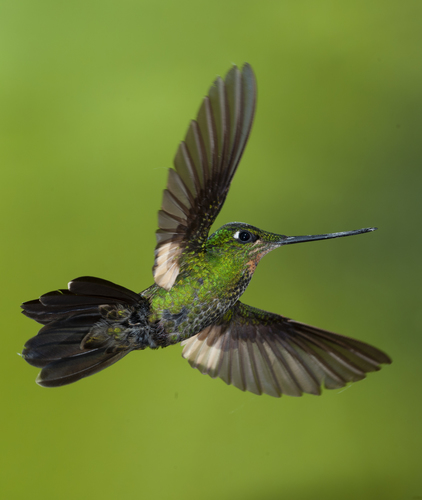
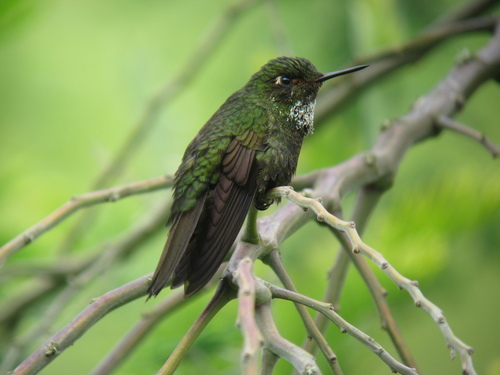
Metallura williami, commonly called the viridian metaltail, is 11 to 12 cm (4.3 to 4.7 in) long and weighs 4.1 to 5.3 g (0.14 to 0.19 oz). It has a medium-length, straight, black bill. Adult males of the nominate subspecies have bottle green upperparts and underparts, a glittering bottle green gorget, and a slightly forked purplish blue tail. Adult females also have bottle green upperparts; their throat, breast, and belly are mottled green and white, and the undersides of their outer tail feathers have whitish tips. Juveniles have a similar appearance to adult females. Four subspecies have distinct physical differences when compared to the nominate subspecies. M. w. recisa has a shorter bill, a more deeply forked tail, and shinier underparts. M. w. primolina has a tail that is reddish black on top, shining green below, and only slightly forked. M. w. atrigularis has a black patch at the center of its gorget, a slightly forked tail, and a shining green tail underside. Each of the four subspecies occupies a separate geographic range along the Andes in Colombia, Ecuador, and near the border of Peru. M. w. recisa is found in the municipality of Frontino, in the Western Andes of Colombia’s Antioquia Department. M. w. williami (the nominate subspecies) is found on both slopes of Colombia’s Central Andes. M. w. primolina ranges from the Andes of southern Colombia’s Nariño Department into Ecuador, extending south as far as Ecuador’s northern Azuay Province. M. w. atrigularis is found in the Andes of southern Ecuador, ranging from Morona-Santiago Province almost to the border of Peru. The viridian metaltail inhabits páramo grasslands with scattered shrubs, as well as the shrubby edges of humid montane forest and elfin forest. In Ecuador, it usually occurs at elevations between 2,700 and 3,600 m (8,900 and 11,800 ft). In Colombia, it can range up to 4,000 m (13,000 ft). There have been confirmed sightings of the species at elevations as low as 2,100 m (6,900 ft).