About Metacarcinus magister (Dana, 1852)
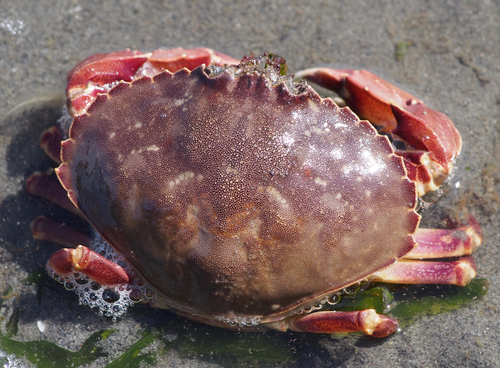
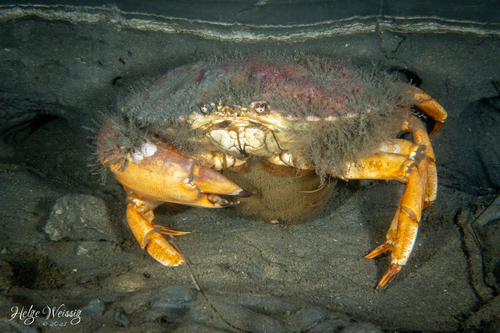
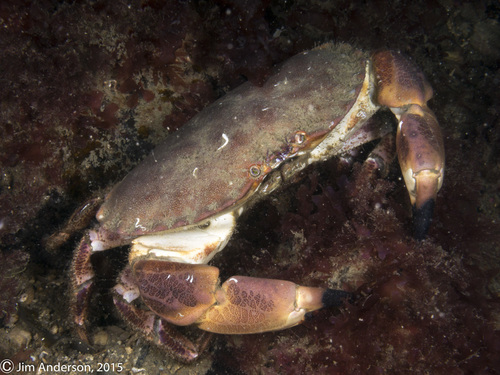
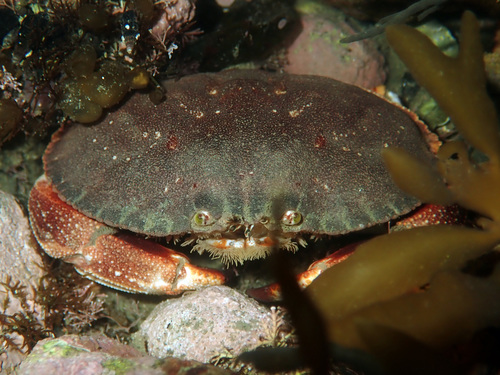
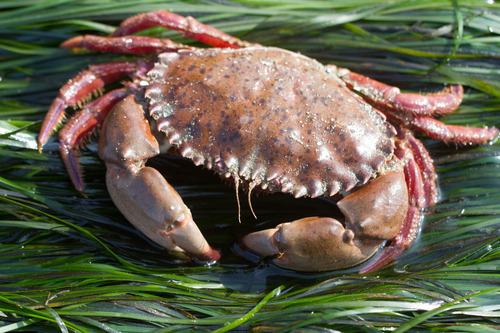
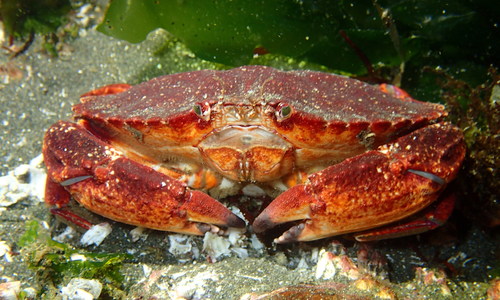
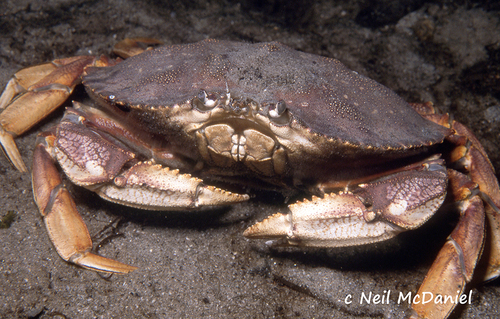
Metacarcinus magister, commonly known as the Dungeness crab, has four pairs of armored legs, two claws, and a wide, hard shell. Compared to other commercially harvested crabs, Dungeness crabs have shorter legs, and their claws feature a distinctive hook. Claws are used for defense and tearing apart large food items; smaller appendages pass food particles into the mouth. After food enters the stomach, it is further digested by the gastric mill, a set of tooth-like structures. To grow, Dungeness crabs must periodically shed their outer shell, a process called ecdysis, or molting. Molting allows crabs to regenerate lost limbs, though the new limbs are smaller after the first molt following loss. During molting, the shell separates at the junction of the carapace and abdomen, letting the crab pull itself out of the old shell. Once out of the old shell, the soft new shell expands with water, allowing the crab to grow 15 to 25% larger than its previous size. For the first few weeks after molting, the crab is extremely vulnerable because of its soft new shell; the shell takes two months to fully harden. In the first two years of a Dungeness crab's life, it molts six times per year. In the third year, males molt twice, while females molt once. After the third year, all individuals molt once per year: females molt in spring, and males molt in summer. Most Dungeness crabs live five years and reach a size of 6–7 inches (150–180 mm) by the end of their lifespan. However, they can live up to eight years along the US West Coast, and have been recorded living up to 13 years in the northern parts of their range. At maximum size, females can reach 7 inches (180 mm) and males can reach 9 inches (230 mm). M. magister prefers to eat clams, other crustaceans, and small fish, and it is also an effective scavenger. Its scavenging habits can even lead it to cannibalize other Dungeness crabs. Genetic analysis of adult Dungeness crabs shows that there is a single population across the California Current System, but interannual variation in physical oceanographic conditions such as ocean circulation patterns likely influences larval recruitment between regions, leading to changes in genetic diversity over time. Dungeness crabs are most commonly found in areas with sandy bottoms, but they can live on a wide variety of seabed types. They occur in high densities from the intertidal zone down to depths of 170 to 300 feet (52 to 91 m), though individual crabs have been found as deep as 2,624 feet (800 m). Adult Dungeness crabs require water with surface temperatures between 38–65 °F (3–18 °C) and salinity between 11 to 35 practical salinity units (PSU). Larvae are much more sensitive to environmental conditions like salinity, and require water temperatures between 50 and 57 °F (10 and 14 °C). The native range of the Dungeness crab stretches from the Aleutian Islands of Alaska to Point Conception, near Santa Barbara, California. Individuals are occasionally found as far south as Magdalena Bay, Baja California Sur, Mexico. Mature female Dungeness crabs generally molt in late spring, though the exact timing differs by location. Mating happens immediately after the female molts, before her new exoskeleton hardens. Males can detect when females are preparing to molt, likely via pheromones, though this has not been confirmed. During each mating season, a male may mate with multiple partners. After finding a receptive female, the male begins a protective premating embrace that lasts for several days. In this embrace, the female is tucked beneath the male, positioned so their abdomens touch and their heads face each other. Sperm from the male is stored in the female's spermatheca, and can remain viable for up to two and a half years. This allows a female to either use stored older sperm, or choose not to mate at all in a given year. Fertilization happens between October and December, when eggs are moved to the abdominal flap of the female. The female extrudes fertilized eggs and carries them on specialized hairs located on her tail flap. Newly laid Dungeness crab eggs are bright orange, and darken as they develop. A single female can carry up to 2 million eggs, with the total number depending on her size; females that use older sperm carry fewer eggs. In winter, a female carrying eggs will bury herself in sand and become inactive to protect her eggs. Eggs typically hatch in spring, though the exact timing varies by location. After hatching, young crabs are free-swimming and perform diel vertical migration, staying at depths up to 80 ft (24 m) during the day. They go through five zoeal larval stages and one megalops stage before settling to the seabed as first-stage juveniles. Free-swimming larval stages usually last three to four months, though in Alaska larvae may remain in this stage for up to a year. Sexual maturity is reached after roughly 12 molts, or two years. The Dungeness crab is considered a delicacy in the United States and Canada. Long before European settlement of the region, Indigenous peoples across the crab's range included it as a traditional part of their diet, harvesting it annually at low tide. Dungeness crab meat has a delicate, slightly sweet flavor that is widely prized. Today, it is a core part of the cuisines of California, British Columbia, and the Pacific Northwest, and traditionally appears in dishes such as crab Louie and cioppino. Approximately one quarter of a Dungeness crab's total weight is edible meat. Dungeness crabs are commonly sold either live or pre-cooked. A recommended humane method for killing a live crab is: first stun the crab by submerging it in ice water for several minutes, then flip the crab onto its back, then drive the tip of a small pick approximately one inch below the center of its mouth. However, many people cook live crabs by simply dropping them directly into boiling salted water. After boiling for 15 minutes, the crabs are removed, placed in cold water to cool, and then cleaned. Cleaning involves removing the shell, scooping out the gills and intestines, and separating the legs and claws from the body. The yellow substance found when the shell is removed is called crab fat or crab mustard; it is not actually fat, but the hepatopancreas, and it is used in many dishes. Another preparation method is called half-backing: the crab is flipped upside down and chopped in half from head to tail, then the guts and gills are scooped or hosed out. Many people consider half-backing superior to cooking the whole crab, because it prevents meat from being contaminated by the flavor and contents of the guts. Half-backed crabs boil faster, or can be quickly steamed instead of boiled. Common tools for removing meat from the shell include a crab cracker and a shrimp fork.