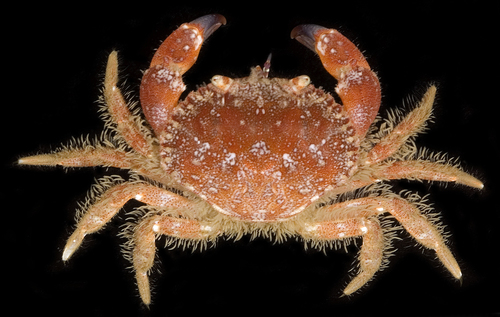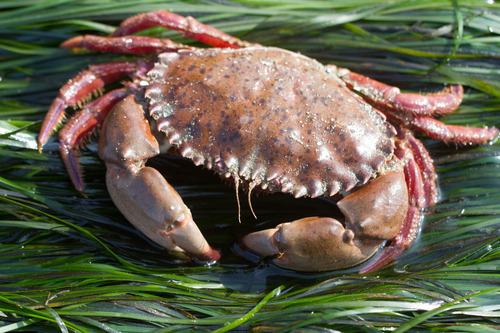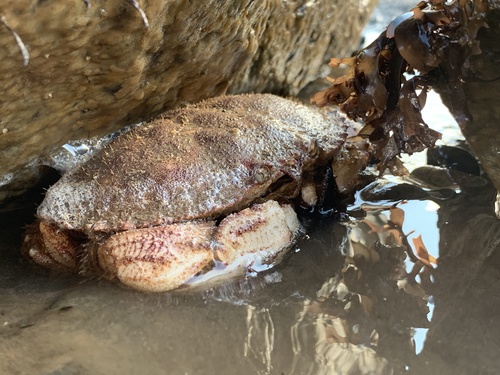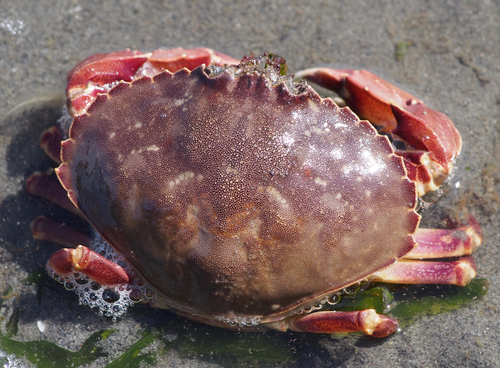
About Metacarcinus anthonyi (Rathbun, 1897)
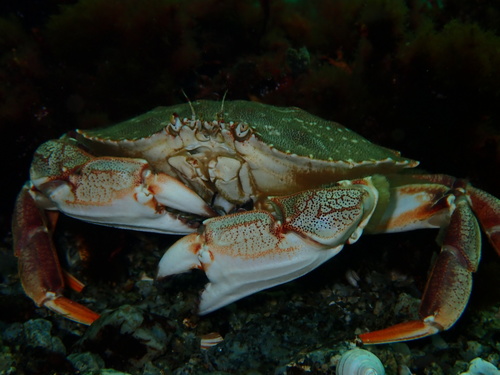
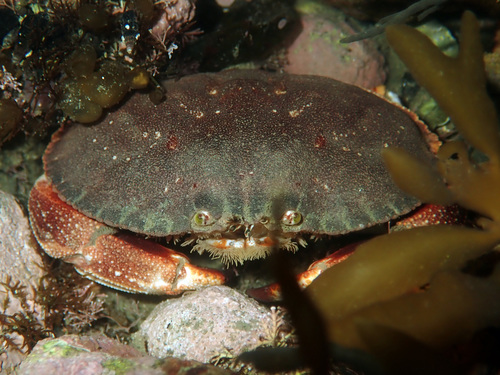
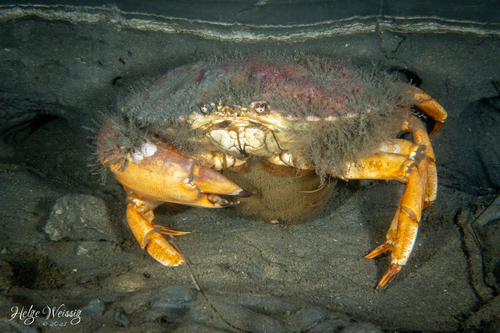
Description: Male yellow rock crabs (Metacarcinus anthonyi) can reach a maximum carapace width of 165 mm, while females reach a maximum of 148 mm. The carapace is oval, quite broad, and is widest at the 9th of 10 forward-curving anterolateral teeth. Like other California crabs from the family Cancridae, M. anthonyi has claws with black tips. M. anthonyi can be told apart from Romaleon antennarium by the lack of red spotting on its underside. M. anthonyi also typically does not decorate itself and usually does not have hairy legs. Its coloration ranges from yellow to brown, with juvenile crabs generally being darker than adult individuals. Metacarcinus anthonyi is one of just two species that regularly grow to the minimum landing size for crabs in Southern California, the other being Cancer productus, and it is targeted by commercial fisheries. Romaleon antennarium is also caught commercially across Southern California. Distribution: Metacarcinus anthonyi is found from Magdalena Bay, Baja California, north to Humboldt Bay in Northern California, though it is uncommon in areas north of San Pedro. It inhabits rocky areas at depths up to 132 m (433 ft). Only juvenile individuals live in the intertidal zone. Some fossils of M. anthonyi dating to the Pliocene and Pleistocene have also been found in central and southern California. Ecology and life cycle: Metacarcinus anthonyi is an ecologically important species. It is prey for many fish species, including scorpion fish, barred sand bass, and other rock fishes. It is also prey for sea otters, which are a threatened species. M. anthonyi acts as both a scavenger and a predator, eating any item its large claws can crush, including echinoderms, snails, and clams. Metacarcinus anthonyi reaches sexual maturity after 10 to 12 molts. Mating usually occurs in June, shortly after females have molted. Before molting, females release a pheromone that triggers courtship behavior in males.