About Mesua ferrea L.
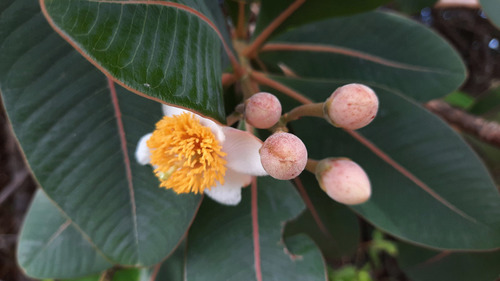
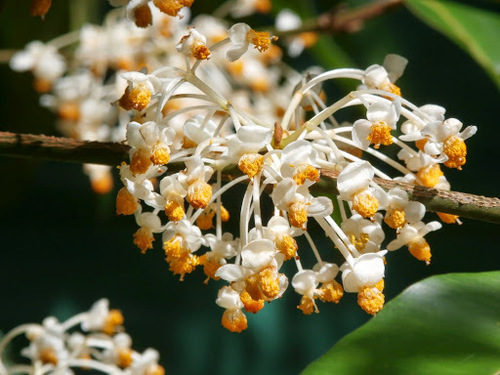
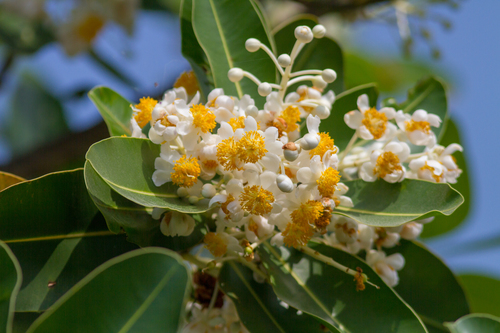
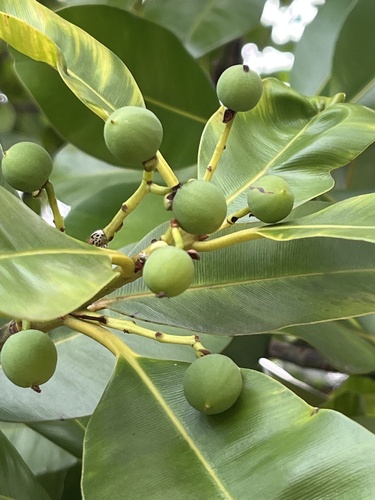
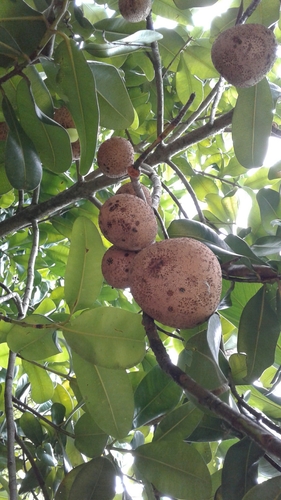
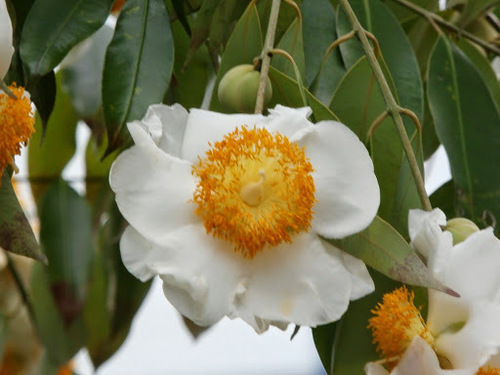
Mesua ferrea L. is a large tree that can reach heights over 30 m (98 ft). Its trunk often grows with buttressing at the base, and can reach up to 2 m (6 ft 7 in) in diameter. Young trees have ash grey, flaky peeling bark, while old trees have dark ash-grey bark marked with a red-brown blaze. The tree produces simple, opposite leaves that are narrow, with shapes ranging from oblong to lanceolate. Mature leaves measure 7–15 cm (2.8–5.9 in) long and 1.5–3.5 cm (0.59–1.38 in) wide, and range in color from blue-grey to dark green, with a distinct whitish underside. Newly emerging young leaves are red to yellowish-pink, and characteristically droop. Mature leaves have a dark green upper (adaxial) surface; their lower (abaxial) surface is whitish from a thick waxy coating. This waxy coating holds nanoscale structures that make the leaf surface water-repellent and hydrophobic, which helps prevent insects from adhering to the leaves. Its branches are slender, cylindrical, and hairless. The bisexual flowers are 4–7.5 cm (1.6–3.0 in) in diameter, with four white petals surrounding a center of numerous orange-yellow stamens. Its fruit is an ovoid to globose capsule that contains one to two seeds. This species is native to wet tropical regions of Sri Lanka, India, southern Nepal, Burma, Thailand, Indochina, the Philippines, Malaysia, and Sumatra, where it grows in evergreen forests, particularly in river valleys. In India’s eastern Himalayas and Western Ghats, it grows at elevations up to 1,500 m (4,900 ft); in Sri Lanka, it grows at elevations up to 1,000 m (3,300 ft). As its common English name suggests, the wood of this tree is very heavy, hard, and strong. At 15% moisture content, its density ranges from 940 to 1,195 kg/m3 (59 to 75 lb/ft3), and the wood is a deep dark red color. It is difficult to saw, and is primarily used for railroad ties and heavy structural timber. In Sri Lanka, the pillars of the 14th-century Embekke Shrine near Kandy are constructed from this tree’s wood. Its flowers, leaves, seeds, and roots are used as herbal medicine in India, Malaysia and other regions, and are also an ingredient in nag champa incense sticks. Before the British introduced kerosene to the region, seed oil from this tree was used daily for evening lighting in Assam, a northeastern state of India; mustard oil was used separately for religious, health, and culinary purposes in the area during this time.