About Mesosphaerum pectinatum (L.) Kuntze
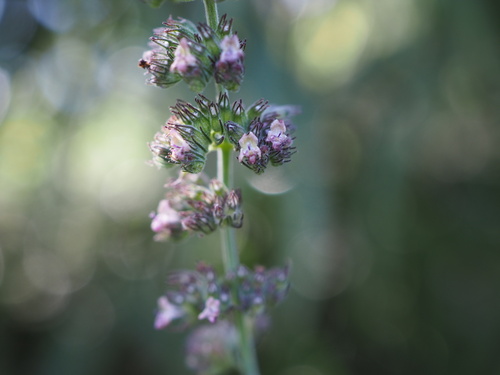
Mesosphaerum pectinatum (L.) Kuntze is an annual or short-lived perennial herb that reaches 0.6–2.3 m (2 ft 0 in – 7 ft 7 in) in height. Its lower stems become softly woody as the plant ages. Leaves are borne on 15–40 mm (0.59–1.57 in) long stalks; leaf blades are ovate to narrowly ovate, measuring 15–45 mm (0.59–1.77 in) long and 10–30 mm (0.39–1.18 in) wide. The upper leaf surface is sparsely hairy, while the lower surface is paler and usually covered in soft white felt. Leaf tips are blunt, leaf bases are truncate, and leaf margins have fine, irregular scallops or teeth. The inflorescence grows at the tip of the stem and is often branched. Flowers are typically arranged in dense, horizontal, comb-like clusters, sometimes paired on a shared stalk, though looser flower arrangements also occur. Lower bracts look like small leaves, and become progressively smaller toward the inflorescence tip; bracteoles are narrow, bristle-like, and around 3 mm (0.12 in) long. The calyx is approximately 2.5 mm (0.098 in) long when the plant is flowering, and grows to 5 mm (0.20 in) long when the plant develops fruit, with dense hairs inside its throat. The corolla is whitish to pale mauve, and around 3.5 mm (0.14 in) long. The native range of Mesosphaerum pectinatum extends from Mexico, Florida, and the West Indies in the north, through Central America, to Bolivia and Brazil in the south. It has become naturalized in the Andaman Islands, Angola, north-east Argentina, Assam (India), Benin, Botswana, Burundi, Cape Verde, the Central African Republic, the Comoros, the Republic of the Congo, the Democratic Republic of the Congo, Equatorial Guinea, Eritrea, Ethiopia, Fiji, Gabon, Guinea, Hawaii, the Ivory Coast, Java, Kenya, Malawi, the Marianas, Mozambique, New Caledonia, New Guinea, the Philippines, Queensland (Australia), Rwanda, Samoa, South Africa, South Sudan, Taiwan, Tanzania, Togo, Uganda, Vanuatu, Zambia, and Zimbabwe. In Africa, the species has been established for a long time and is often considered native. It grows in hot, wet environments, most commonly on disturbed ground, where it can become particularly weedy.