About Mesocentrotus franciscanus (A.Agassiz, 1863)
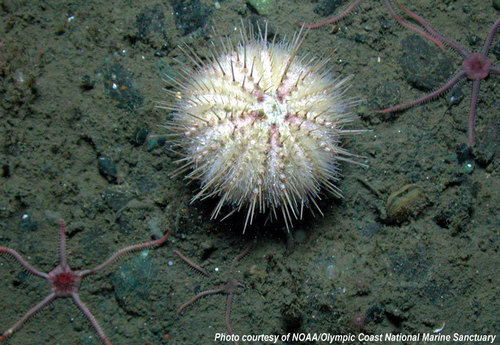
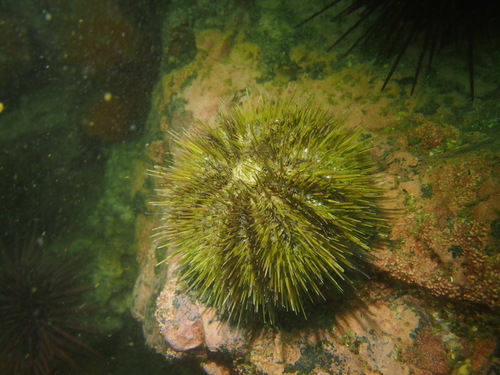
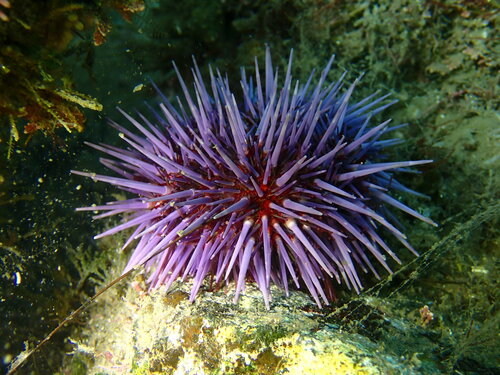
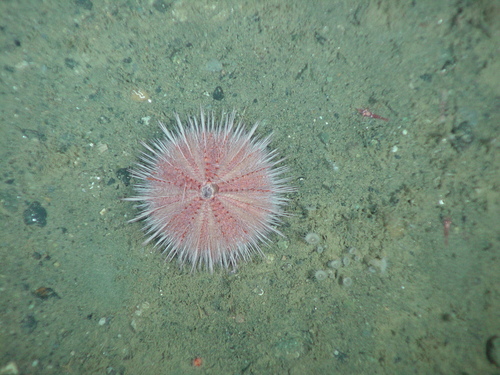
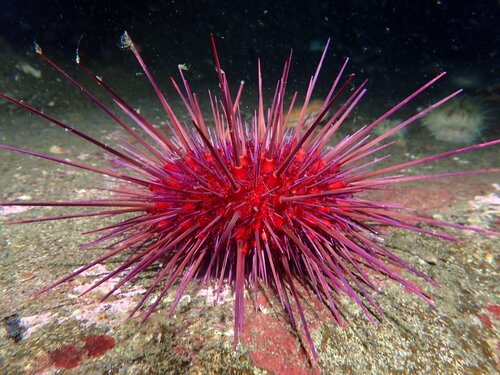
Mesocentrotus franciscanus is a species of sea urchin. It has a spherical body completely covered in sharp spines. These spines grow from a hard shell called the "test", which encloses the entire animal. Its color can range from red to dark burgundy, and albino specimens are found rarely. A mouth surrounded by five teeth sits on its underside. During larval development, the sea urchin's body transitions from bilateral symmetry to radial symmetry. Its bilaterally symmetrical larval form is called an echinopluteus, which later develops the pentaradiate symmetry that is characteristic of echinoderms. This sea urchin crawls very slowly across the sea bottom, using its spines as stilts with assistance from its tube feet. Rows of tiny tube feet with suckers are scattered among the spines; these help the urchin move and adhere to the sea floor. This species is often found living in clumps of five to ten individuals. It has the ability to regenerate lost spines. Its lifespan often exceeds 30 years, and scientists have documented some specimens over 200 years old. Red sea urchins (Mesocentrotus franciscanus) are notoriously ravenous consumers of kelp. They are implicated in devastating kelp beds by forming grazing fronts. The intense grazing pressure from these urchins forms an important link in a trophic cascade commonly observed along the west coast of North America, where sea otter predation influences urchin abundance, which in turn influences the level of kelp devastation. In contrast to their negatively perceived impact on community structure in open coastal kelp beds, their sedentary behavior and capture of detrital seaweed in the San Juan Islands is hypothesized to create important habitat and an energy source below the photic zone. These diverse ecosystem effects highlight the importance of red urchins as ecosystem engineers in temperate rocky reef ecosystems. The species' spawning peaks between June and September. Eggs are fertilized externally while floating in the ocean. Planktonic larvae stay in the water column for about one month before settling on the sea floor, where they undergo metamorphosis into juvenile urchins. These juveniles use chemical cues to locate adults. Although juveniles are found almost exclusively under aggregated adults, the adults and juveniles in these groups are not directly related.