About Mesembrina mystacea (Linnaeus, 1758)
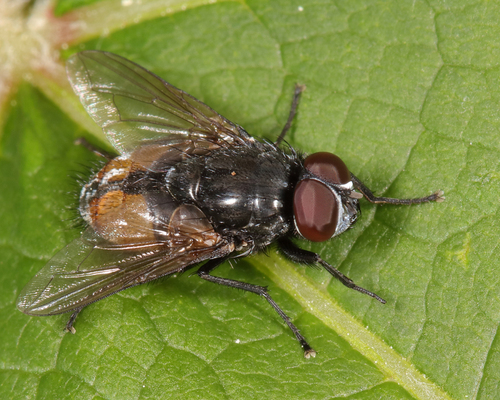
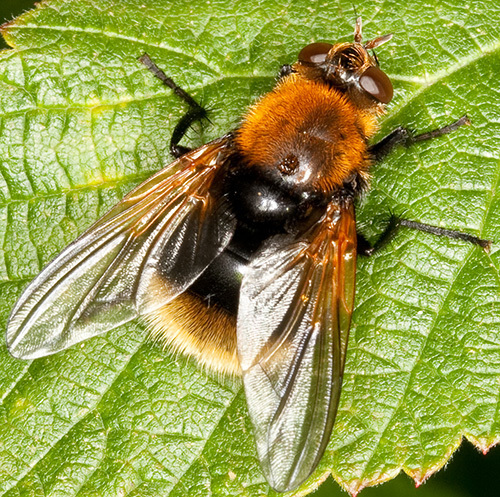
Mesembrina mystacea (Linnaeus, 1758) reaches a body length of 9–12 millimetres (0.35–0.47 in). These are large, distinctive stout-bodied flies with striking coloration in black, yellow-brown, and white. Most of their long body hairs are black, but they have a band of fine short yellow-brown hairs running anteriorly across the thoracic dorsum, dense brown hairs covering the abdomen, and white hairs along the abdominal edge. Both the metathorax and abdomen are shiny black, and their eyes are bare. The base of the wings has a large orange patch. This species shows clear sexual dimorphism: the anterior yellow-brown thoracic hair band is much narrower in males than in females. Additionally, male mid tibiae are curved and bear longer hairs, while female mid tibiae are straight and lack long hairs. These flies closely mimic bumblebees of the genus Bombus, which belong to the Apidae family. They are also very similar to the hoverflies Criorhina berberina and Pocota personata in the Syrphidae family, and superficially resemble another hoverfly, Volucella bombylans. Among all Mesembrina species found in western Europe, M. mystacea is the only one that acts as a bumblebee mimic. This species occurs across the Palaearctic realm, ranging from Fennoscandia south to Turkey, and extending from the Atlantic coast across Eurasia all the way to Mongolia. Adult M. mystacea are active from June to September. Their larvae feed on dung and dead organic material. In western Europe, this species is a forest insect, found in woodlands or grazed cattle areas within the Quercus, Fagus, and Picea vegetation zones. It is an insect with complete metamorphosis that includes a pupal stage.